Showing posts with label Victorian Characters. Show all posts

Tuesday, July 23, 2013

The (New) Art of Space 1889


I've posted several pieces of art from the German (and soon to be English language)  Space: 1889 basic book before, including character archetypes. Those were done by Mia Steingraeber and have been big hits with about everyone who's seem them. The above one is not from the main book, but instead is a sample archetype from the forthcoming Venus sourcebook. Here's a link to the HeroPress site giving a little more info about the new Space: 1889 art, as well as al update on the Kickstarter project.


Sunday, May 13, 2012

Game Pictures From Little Wars

Since travel has kept me from posting as often as usual the last two weeks, it's only fair you see some pictures from the games I've been running. Tom Harris and I ran a big game up at Little Wars two weeks ago and I ran anothe game out at Border Wars in Kansas City a week back. These pictures are all from the  Little Wars game, but the Border Wars game was visually similar.

The main difference at Border Wars was I tried out a little more detailed system for the game encounters, which tied them (and the associated wonders) to three general geographic types: Higland, Arboreal, and Lowland. That helpedthe game, as skills like botany and animal were more valuable in arboreal encounters, artifact in lowland encounters, and minieral more in highland encounters (at least for the wondes, and often for the encounters as well) it gave the players a little more strategy to deal with in sending their expedition around. There's still a high level of the unexpected, but players feel as if they can exert at least some influence on it. I think referees who use the system for running a specific crafted episode can use this to benefit as well -- for example giving an expedition a native guide or naturalist to forge a way through the steamy jungle to get to the Valley of the Kings, where the archaeologist will come in handy. (Oh, the killer vines got him? Bummer.)


To start with, here's a picture of the Japanese Hunting Party about to experience a Highland encounter. This also shows off the detail in the great highland terrain my pal Glenn Kidd made for the game last year. I don't know if I've shown you this before, but I made up these encounter markers with two exotic vases on them to mark the encounter points on the table. You need something which does not detract from the overall look of the table and these are just the ticket. I got the idea from Frank and Christin Sciuli who did a bunch of these for the White Pearl Black Heart game Glenn Kidd runs with Frank Sciuli a lot. (I'm not sure if Frank or Christin came up with the idea.) The "vases" are actually colored beads which come in a large plastic packet -- a lifetime supply for a couple bucks -- at most big craft stores. I just glued two to a round base and did a very little landscaping on the base. The beads are pretty glossy right out of the packet, but a quick drybrush in earth tone color fixes that. They come with the carved patterns already inked so that's all there is to it. If you were really ambitious you could paint a bit on the designs on the vases as well, but since I needed over twenty of these, this was good enough for me. There is enough variety in beads in the packet you end up with a nice mix of markers.


Here's another Highland encounter, this time the Belgians have run into a delegation of Hill Martians who have taken the opportunity to lodge a vigorous protest against King Leopold's colonial policies in the Coprates Rift Valley. Fortunately the Germans have decided to help them and a unit of Venusian Schutztruppen have charged the Hill Martians from behind, all but wiping them out.The two survivors fled immediately after this, as I recall.


Tom Harris has made up terrain peices which represent most of the wonders encountered, and while they are not absolutely necessary, they add a lot to the visual aspect of the game. Here the British discovered a large fossilized animal and we discovered the terrain piece fit perfectly on the mountain ledge where the encounter took place.


Certain types of "wonders" are associated with specific encounters. Most of the encounters with parties of native Martians involve freeing a prisoner or prisoners. By the same token, an encounter with native Martians does not have to end in violence. There is a listed chance the natives will attack immediately, modified if you have a character present with Native skill (a local guide, a Martian shaman, etc.) If they do not attack, you can of course attack them and get the element of surprise. However, if you do not attack, they roll again the next turn to see if they attack, and if they decline a second time they join your party and surrender up whatever wonder they were guading. In this case the Belgians have decided to break with tradition and try a peaceful approach to the locals, which has paid off handsomely. A party of ten Hill Martians joined their expedition (figures on the right) and freed a group of five European prisoners they had been . . . protecting. Yeah, protecting, that's it! The Europeans, spent by their ordeal, are about to board the Belgian steam lorry.


Here the Anarchists are about to come into conflict with the Japanese over who has access to whatever wonders are within the Village of the Pink Birds of Prey. The front rank of the Anarchists are a  unit of Evil Minions armed with electric rifles, and supported by a gaggle of clockwork spiders. The minions are figures from Parroom Station and the clockwork spiders are my conversions.


The clockwork spiders attack! It's always gratifying to to see your creations used for their intended purpose. Bwaa-ha-ha!

We've got some more pictures of the game and I'll post them in a few days. This should hold you for the moment, however. And tomorrow I'm going to post some really big news.

Tuesday, April 17, 2012

Character Art from the German Space 1889 Game


The German Space 1889 role-playing game will be released later this year by Uhrwerk Verlag and here is a sneak peek at two of the character archtype illustrations: the female scientist and the gentleman adventurer. I love this artwork! If the rest of the game is to this standard (and that of the other material I've seen) this will definitely be a winner.

These were posted by Patric Goetz of Uhrwerk Verlag on the new Space: 1889, Science Fiction Roleplaying In a More Civilized Age Facebook page. I've added that to the links section (as Space 1889 RPG, because the full title wouldn't fit). The page was just started within the last month or so but is active and will probably see a lot of news of upcoming products as well as discussions about the game. Worth a look.

Wednesday, April 11, 2012

Murdoch Mysteries: A Fun Steampunkish TV Series


I recently was pointed to a very fun TV series with a definite Steampunk flavor, called Murdoch Mysteries. It's a Canadian-produced series now in its fifth season and available through a variety of cable outlets and on DVD, but also with a lot of episodes up on YouTube. It follows the crime-solving career of police detective William Murdoch in 1890's Toronto, Canada. He uses many unconventional scientific techniques to solve cases -- fingerprints, trace evidence, etc. -- and is supported by his young assistant Constable Crabtree, his superior Inspector Brackenreid, and the lovely medical examiner Doctor Julia Ogden. The show has frequent nods to future science and regular encounters with famous historical characters. Nikola Tesla is in the first episode (dealing with a murder by electrocution and touching on both the commercial struggle between AC and DC current and the bitter rivalry between Tesla and Edison). H.G. Wells, Buffalo Bill Cody, Jack London, Arthur Conan Doyle, and Queen Victoria all appear in various episodes, to drop just a few names.

It's good fun. I think it suffers a bit from having only four regulars, which is a bit thin for an ensemble cast, (seven or eight seems about right) and a bit much for a classic mystery duo (Holmes and Watson, Poirot and Hastings, Dalziel and Pascoe, etc.), which keeps the character interactions between them fairly predictable. That said, the show is great fun and touches on a few interesting social issues, including the impossibility of Murdoch ever rising above detective due to his catholic faith.

Here's a link to the first episode on YouTube, the one featuring Tesla. It's worth a look. See if you like it.

Friday, December 23, 2011

Historical Characters in Steampunk


Some writers set their steampunk fiction in worlds so dramatically removed from our own there is little reason to expect historical characters to show up. Many worlds, on the other hand, are closer to our own reality and Space: 1889 certainly is among that number. Writers crafting stories in that setting naturally need to pay attention to what historical personages the novel's characters might bump into as they go about their business, and the same is true for GMs constructing adventures. That said, novelty is the key to all good stories and adventures, and so a continuous parade of Very Famous People never seems very plausible. Young Winston Churchill followed by young Teddy Roosevelt, followed by young someone else wears thin fairly quickly, and strains credibility as well, as the coincidental "star sightings" pile up. So what's a person to do?

Here's a technique I've found useful, and it's one everyone can do who has access to the internet -- which means everyone within sound of my electron-carried voice. In a story I'm writing I wanted to know who was who in the Austro-Hungarian embassy in London in 1889. The ambassador is pretty easy to track down, but his pay grade is way above the sort of people to whom my characters are likely to gain introductions. No, I needed the clever under-assistants, but where on Earth do you find that, without going to Vienna and digging through musty archives?

I reverse engineered the problem, because I wasn't just looking for an underling, I was looking for one who might be historically interesting. So I researched Austro-Hungarian ambassadors in the years leading up to and during World War One, or about twenty to twenty-five years later. I needed an English speaker so I looked at ambassadors to England and the United States, and then checked their biographies (mostly available at least in abbrevaited form on line) to see who, if any of them, had served in the London embassy in the 1880s.

Oh, my. Jackpot! I give you Konstantin Theodor Dumba.

Dumba, born in 1856, entered the Austro-Hungarian foreign service 1879 at the age of 23 after obtaining a doctorate in law, so he was clearly a bright and hard-working student. He served in the London embassy as a staffer from 1881 through 1886, apparently his first overseas assignment. Later he was sent to other European postings, but since my story involves the Austrian response to the assassination of their ambassador in London, and his hasty replacement with another diplomat, it makes sense the Austrians would call back a junior staffer with extensive experience in Britain to help the new ambassador find his feet. But what makes Dumba particularly interesting is the later part of his career. He was the last acredited ambassor from Austria-Hungary to the United States and was expelled in 1915, before the U.S. entered World War One, for his involvement in a plot to sabotage U.S. arms manufacturing.

So here we have a bright, ambitious, and highly competent junior staffer, thirty-three years old, fluent in English with connections to the British Foreign Office, and having at least a latent interest in espionage and the more dangerous side of international affairs, as well as probably a relaxed attitude toward inconvenient obstacles such as the law. Now that's an interesting historical character, and the advantage of drawing on a real person for this is that he begins to do part of your work for you, giving you clues as to how he would react to a situation -- sometimes in ways you might not have come up with on your own.

The world is full of intriguing people and each one has a story to tell you. You just need to look and listen.

Thursday, August 25, 2011

Two More Figures from Highlander Studio

Here are two more wilderness adventurers in 15mm from Rod at Highlander. I like these a lot because they are based, directly or indirectly, on historical characters.


This first figure is an explorer, and a fine confident fellow he is. The figure is based on the American Henry Morton Stanley, sometime journalist, explorer, soldier of fortune, and eventually empire-builder in the employ of King Leopold of Belgium. He made his name finding the missionary/explorer Dr. David Livingstone, supposedly greeting him with the now-famous words, "Dr. Livingstone, I presume?" Stanley also made his name "rescuing" Emin Pasha near the headwaters of the Nile , although Emin Pasha did not think he particularly needed rescuing, and later complained that Stanley's arrival destabilized a situation Emin already had well in hand. Certainly Stanley's lasting accomplishment, if you care to call it that, was the brutal conquest of what became the Belgian Congo, a place which arguably has not recovered to this day.


Rod says this next figure, a hunter, is loosely based on Alan Quatermain, who of course is a fictional character from the pen of H. Rider Haggard. What Rod probably didn't know is that the fictional character Quatermain was based on a real-life adventurer, an Irishman named Charles Stokes, who went down in history as Bwana Stokesi. Explorer, hunter, ivory trader, and scoundrel, he certainly inspired the darker side of Quatermain's character, along with his physical courage, thirst for adventure, and at least some of his roguish charm.

There's an interesting historical intersection between these two figures: Stokes was hanged in 1895 in the Congo by a Belgian colonial official for illegal trading, so indirectly his demise was a product of Stanley's handiwork.

Well done again, Rod. Keep 'em coming.

Saturday, July 16, 2011

First Look at Highlander Studios Figures

Last week I attended Historicon in Valley Forge, PA. Rod Campbell of Highlander Studios was unable to attend due to illness in the family, but he sent me some master figures for approval and just sent pictures of some painted miniatures. I like them a lot, and I'm used to looking at 25mm figures instead of 15s. See what you think.


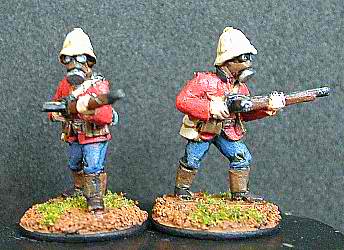
Here are some British infantry in gas masks and carrying advanced magazine rifles. Rod plans to do these both with and without gas masks. These first ones give a good feeling for proportion and level of detail.

Here are two adventurers kitted out for wilderness exploration and also packing some interesting weaponry. Nice faces, especially for 15s.

These are from the American Adventurers pack, although I suppose they would work just as well for anyone who likes body armor or bags of cash. (I'm guessing that's what's in the bag in any event -- those American arms dealers aren't in it for their health, after all.)

Here are two views of Rod's gashant, sans rider to show off the details of the beast. One of the limitations of the 25mm line GDW sold way back when was the shortage of cavalry. The gashant was so massive, and used so much lead, it was never economical to do a set of cavalry -- or rather we would have had to charge too much to make the product attractive to consumers. 15s use so much less metal that the unit costs have as much to do with packaging, labor, mold-making costs, etc. Making a slightly larger piece like this isn't free, but it's less likely to break the bank in this scale than it was in 25mm, so expect to see various units of cavalry in the line.

A good start, although now I am becoming more impatient for the line to be ready.

Friday, May 6, 2011

Happy Birthday Sir Harry Flashman

I am greatly remiss! A good friend pointed out that yesterday was the birth anniversary of the late Sir Harry Paget Flashman, VC, KCB, KCIE; Chevalier of the Legion d'Honneur; U.S. Medal of Honor; San Serafino Order of Purity and Truth, 4th Class.


Sir Harry was born on May 5, 1822, and his storied career included encounteres with the "White Rajah" of Sarawak, Queen Ranavalona of Madagascar,  the Emperor Maximilian of Mexico, and Otto von Bismark, among many others. His service in armies other than that of Great Britain included a hitch as a major in the Union Army and one as a colonel in the Confederate Army, both during the American Civil War. His literary works included Dawns and Departures of a Soldier, Twixt Cannon and Cossack, and the ever-popular The Case Against Military Reform. If literature has ever provided a more remarkable rogue, I'd like to meet him.

Happy belated birthday, Sir Harry!