Showing posts with label Writing. Show all posts

Sunday, March 30, 2014

What I've Learned From The Less-Than-Brilliant (and Sometimes the Brilliant)


I try to read widely and sample a lot of different authors, genres, and styles. Lately I've been off on a different sort of reading jag: I've been reading bad science fiction which sells well.

Now, let me explain that. In my view it isn't really bad if it sells well, because we write these books to entertain, and if lots of people find a book entertaining, it has succeeded in its essential purpose. It has "lived a life worth living." That said, these books do not meet the normal standards for good writing, and I don't just mean for flowery literary fiction; I mean the standards for the genre itself, science fiction. Nevertheless they sell. So what's going on there? That's what I wanted to find out by reading them. I'm not a cynical guy and I have no contempt for my audience, so my baseline assumption here is that they are doing something right which readers recognize but lots of us writers don't.

I believe in reading good writing as an essential way of improving your own writing, and I'm by no means giving up on that. But it occurred to me that when you read an author who does everything right, it's hard to tell which of those brilliantly executed passages are critical to her success and which are pleasing but less essential. But when you read an author who does almost everything poorly, but whose books still find a wide readership, you can be pretty sure that whatever he's doing right is pretty important. And finding it isn't exactly like finding a needle in a haystack.

I won't tell you which authors I read for this experiment because I'm not in the business of running other authors down, even by means of faint praise. I'm not a critic, I'm a writer. But what did I find? Good characters? Absolutely not. At worst they were annoying stereotypes; at best they were skill sets with one quirk thrown in to make them "colorful." Great description? No. Strong sense of theme? Nope. Redemption and a moving character arc? No way. Exciting action scenes? Sometimes, but not always or even most of the time. Imaginative world building? Nuh-uh. Intricate, original plot? Pah!

No, here's what I found those writers were very, very good at: pacing.

The one thing they seem to know well is how to move a story along briskly, scene after scene after scene. They don't lumber the front of the story up with lots of backstory.( Sometimes this is because they don't seem to have thought much about backstory, but that's a different issue.) They don't have long draggy parts in the middle where characters flounder around for pages searching for meaning and fulfillment. Scene follows scene, conflict draws the reader along. They are, in short, "page turners," if nothing else. And to be honest, sometimes they are not much else, but they are at least that.

Coincidentally, not long after I finished that reading project I picked up Harlan Coben's "Tell No One," his very first New York Times best-seller from back in 2001. Coben has become a go-to guy for crime thrillers, a solid and respected genre author, and it was fun to read this early work of his. Man, does he know how to pace a book! Kept me up until 2:30 in the morning finishing it. He has a lot of other things going for him as well, but there are also some thin parts of the plot and some places where character motivation doesn't bear too critical an examination. But the pacing just sweeps you along past those and I mostly didn't notice until I thought more about it afterwards.

So what have we learned today? I am beginning to think pacing may be the single most important determinant of success in mass-market genre fiction, and by success I mean reader satisfaction. It is the beating heart of what keeps a reader reading, what keeps her involved in the story page after page..

And the great thing is that brisk pacing does not exclude any other technique. All the chops you can bring to bear on character, plot, setting, theme, and language don't get in the way of pacing one bit if you do them right. 

Saturday, March 29, 2014

Another Nice Review of How Dark The World Becomes


Here is a link to a nice review of How Dark the World Becomes from Astro Guyz, the science (with a heavy emphasis on astronomy) and science fiction blog by David Dickinson. This review hit last year but for some reason I missed it until just now. I like the fact that he picks up on the book's unique (or at least uncommon) treatment of humans in a multi-species confederation, i.e. we're on the bottom instead of the top.

Thursday, March 20, 2014

The Contest With No Prizes -- Lucky Winners Announced

Alas, there are no lucky winners. No one took me up on my generous offer of no prizes for figuring out the three word plays embedded in the short story "Murder on the Hochflieger Ost." For the curious, here are the answers.

You may recall that I said there were three embedded word plays. One involved an artifact, which I though everyone would get. One involved a location, which I thought would be harder. The last one, involving a character's name, I though would be all but impossible.

The Artifact
When explaining why the plans of the aether battleship are of no use to the French, Renfrew explains that they do not include the plans for the analytic engine which makes the ship so powerful. The analytic engine in question is the Improved Babbage, Model Three Hundred and Sixty.

IBM-360? Nobody caught that? Really?

The Location
Gabrielle's false business card lists the address of her appraisal firm as 13 Rue Madeleine, Le Havre, France. In the 1947 James Cagney World War II espionage film 13 Rue Madeleine, that is the address of Gestapo headquarters in Le Havre.  

The Name
Etienne Villon thinks of Gabrielle Courbiere as having the strength and majesty of a mountain, and when he thinks of her as Mont Courbiere he likes the sound of the name.

Francois Villon is probably the best-remembered French poet of the late middle ages, known probably as much for his remarkably adventurous life as for his writing, and his life formed the inspiration for Bertold Brecht's "Baal" and "Threepenny Opera," the Friml operetta "The Vagabond King", and the novel, play and film "If I Were King." Villon's birth name was probably Francois de Montcorbier.

He liked to sprinkle his poems with hidden jokes.
 

Sunday, March 16, 2014

The First Ten Pages

Mickey Spillane (an under-rated writer) once said that the first chapter of a book sells it and the last chapter sells the next book. There's a recognition in that as to how important the opening of a book manuscript is. It's not a secret. People have been talking about this through much of the twentieth century, with increasing urgency toward the end. Given the rapidly escalating volume of material turned out by aspiring authors, and the tightening of standards by publishers, getting through the agent and editor gatekeepers became an area of special knowledge all its own.

This has come to mind as I'm preparing (well in advance) to teach an introductory course on writing the novel later this year. This notion of the importance of beginnings may be the single most critical idea to communicate to aspiring authors, and I've been thinking a lot about how to go about it.

One of the books produced over a dozen years ago in response to the narrowing of opportunities for writers trying to break in was The First Five Pages by Noah Lukeman (2000, Simon & Schuster), a treasure-trove of useful no-nonsense advise to any fiction author, written from the perspective of what editors and agents look for as a key to rejecting, rather than accepting manuscripts. His point is simple and clear: most submissions are rejected for specific reasons which are found in the first five pages of the manuscript. Donald Maass in Writing the Breakout Novel (2001, Writer's Digest Books) makes a similar point, although he is prescriptive rather than proscriptive. He emphasizes what has to be established in those critical five pages rather than what has to be avoided.

So when I give craft talks at writers' groups, or sometimes when I critique a manuscript for someone, I'll frequently come back to the importance of a strong opening. Sometimes I get nods, but I can tell the person I'm talking to isn't completely sold. Readers need all this background information (they say, perhaps only to themselves) in order to understand the real story when it comes later. Besides (they say), many best-selling authors take their time getting started. Sure (I tell them) and when you're a best-selling author with a giant fan base, you can too. Until then, this is important.

But how important? Well, I think I finally know how to convince them. I was talking to another author in one of my writers' groups and his agent was telling him of an interesting development in publishing. Now that Barnes & Noble is effectively the only nationwide book chain, large publishers have a hard time making money from a traditionally-produced paper book unless B&N picks it up for their chain. A publisher needs that first big shot to justify the up-front investment in a print run. So at least one major publisher now has office space set aside for readers from B&N who vet manuscripts and give a thumbs-up or -down.

Now here's the really interesting part: they only read the first ten pages.

Before you go crazy with how unfair or unreasonable that sounds, remember that B&N knows how their customers shop. Customers come in to browse, they pick up a book, they read a few pages, and if it doesn't grab them, they return it to the shelf and move on.

I don't think they're crazy to think that. I've done exactly that many, many times. I remember picking up Michael Chabon's The Yiddish Policemen's Union (2007, Harper Collins), reading the first two pages, and immediately going to the checkout lane and buying it.

If anything, by giving authors ten pages instead of five, they are being generous.

Saturday, January 18, 2014

A Nice Review of "How Dark The World Becomes"

I've been pleased with the reception of How Dark The World Becomes. It's gotten a solid 4.6 stars on Amazon, with only a single three-star review and all the rest fours and fives. It hasn't gotten a lot of published reviews, however, so I was glad to see the SFcrowsnest site in the UK post a nice review last month. Here's a link.

I'm pleased by the review not only because it's positive, but particularly because the reviewer, Kelly Jensen, finds the strengths of the story to lie above all in its characters and world building, which are two of the three parts of the novel I like most and worked hardest on.

For those curious, the third part (for me) was pacing.

On January 9th I also got a short but nice review in  the Philadelphia Weekly Press from Henry Lazarus. "Very exciting," the review claims (in part--it's not that short). I guess he noticed the attention to pacing.

Friday, January 17, 2014

Descriptive Prose

I write pretty much full-time these days so expect some blogs about writing now and then. Can't help myself.

I recently read James Lee Burke's early novel THE LOST GET-BACK BOOGIE, which was nominated for a Pulitzer in addition to re-launching his career. I've enjoyed his writing for many years but had never read this early novel and I'm very glad I did.

Burke is a master of descriptive prose. Some criticize him for going to that well too often, or for dipping too deeply. Me, I eat it up.

The novel is the story of two men who have made some seriously bad choices and are trying to put their  lives back together. One (Buddy, a blues piano player) dies, but the protagonist survives and finds a measure of peace, as the end suggests. Here are the last two paragraphs of the novel:

It’s May now, and the runoff from the snowpack on the mountain behind my house has filled the creek bed in the canyon with a torrent of white water that bursts over the boulders in a rainbow’s spray, lighting the pine and fir trees along the bank with a dripping sheen, and then flattens out at the base of the mountain and runs in a brown course through the pasture toward the river. The grass is tall and humming with insects where the water has flowed out into the field, and occasionally I can see the sun flash on the red beaks of mudhens in the reeds. The river is high and yellow, the sandbars and gravel islands have disappeared under the churning surface, and the bottoms of the cottonwoods cut long, trembling V’s in the current. I can feel the spring catching harder each day, and the irrigated fields across the river are a wet, sunlit green against the far mountains and the patches of snow still melting among the pines on the crest.


In the early evening it turns suddenly cool, you can smell wood smoke in the air, and mauve shadows fall across the valley floor as the sun strikes its final sparks against the ridge. From my front porch I can see Buddy’s cabin faintly in the gathering dusk. Even after it has dissolved into the darkness and black trees and the laughter of his sons playing in the yard, I can still see it in my mind’s eye, lighted, the wood stove lined with fire, and sometimes in that moment I’m caught forever in the sound of a blues piano and the beating of my own heart.

Beautiful, isn't it? Spring coming to the valley is an obvious metaphor for the protagonist's own possible rebirth--so obvious I think it would be clichéd if it weren't for Burke's prose.


Why does that prose lift this metaphor from cliché to something profound? I think it's because what we really see here is the rebirth of the ability of the protagonist to experience and appreciate beauty and the promise of life. This isn't what the coming of spring looks like; it is what it looks like to him. That he is capable of noticing this amazing level of detail tells us more about his soul than about the mountain valley.

I think that may be part of the secret to powerful descriptive prose: it has to tell us as much or more about the character noticing the thing as it does about the thing itself, because stories are about characters, not things, right?
 
I think another part lies in the fact that stories are about change. That's what distinguishes them from sketches and vignettes.  Very powerful description doesn't just tell us what a thing is, it shows us that thing in a moment of the present as it careens along the path from what it used to be to what it will inevitably become. But for just this one fleeting instant it is this.

That's part of it, part of great descriptive prose, but not all of it. Passages like this probably can't be completely deconstructed, analyzed, and explained without losing some of their magic. And maybe that's the real secret of great descriptions--magic.


*****

Sorry there's so much variation in font style and size. I've fiddled with this for an hour trying to get it right and Blogger (the host site) just won't cooperate. It's getting very fiddly lately, sending me odd messages about incompatible browsers (same one I've always used). I hope we're not building up to a crash of some sort, but we'll see.

Friday, January 3, 2014

Happy New Year!

Happy New Year one and all! 2013 was a busy year for me, and a very good one. I have a number of resolutions for the new year, one of which concerns this blog. I'll leave what that resolution might be to your collective imaginations.


The immediate news is that The Forever Engine will be on the shelves in bookstores within the next week, and also available in all e-formats from Baen Books (here's a link to their site) and also available online in paper and Kindle versions from Amazon. I received a very nice advanced review in Publishers Weekly back in the November 4th issue. Here's what it said, in part, with potential spoilers left out:

"Legendary game designer Chadwick taps into his popular Space: 1889 steampunk setting with this exciting prequel novel, which sees soldier-turned-historian Jack Fargo catapulted from 2018 to an alternate 1888 by a mysterious explosive event. Although alternately amazed and baffled by a world that features airships, interplanetary travel, America split into the Confederate States and the United States, and Europe laid out along different political lines, Fargo just wants to go home. . . .(T)he world building is rock solid, the plot fast paced, the action visceral, and the stakes high. Chadwick balances scientific theory, steampunk imagery, and memorable characters with flair. . . "

I blush.

Relating to the novel, Baen Books (my publisher) and I also have a New Year's present for you. They contracted a short story from me as a prequel to the novel and as a way of giving a little more background on one of the characters. The story is called, "Murder on the Hochflieger Ost," and takes place a year before the events of the novel on an enormous luxury zeppelin plying the Berlin-to-Istanbul route--the Space: 1889 equivalent of the Orient Express. It's a free download at the Baen Books site. Just click on this link.

Tony Daniels, my editor at Baen Books and a fine writer in his own right, had some great ideas for the rewrite and nudged me toward a far better final resolution, in my opinion. A book ends up being a collaborative effort and much of the success stems from the help the author receives from others. It still ultimately comes down to the author, but I think the current trend toward self-publishing risks losing some of the collaborative effect of going through a publishing house. Yes, you can hire editors and proofreaders, but I'm not sure it's quite the same thing. Nevertheless, it's certainly here to stay, and will certainly become an increasing part of the literary scene. The economics of publishing almost dictates it for most writers. Who knows what the future will bring, but I'm happy to be with a publishing house like Baen, one that's still intimately connected to their authors and to their customers.
 

Monday, August 12, 2013

Final Edits In on The Forever Engine


I received the final marked up copy edits of The Forever Engine a little over a week ago and just express mailed them back to the folks at Baen Books with all of my final changes. Paul Witcover at Baen did a very thorough and professional job on the copy edit and caught a  couple places where I had unintentionally mangled Gabrielle Courbiere's (the heroine's) French. That would have violated one of my cardinal rules: never make a determined woman with a lever-action shotgun look bad. Thanks for the catches, Paul.

In order to check all the edits I had to read the novel again, I had a good time doing it even though there obviously wasn't a lot of suspense for me. I couldn't tell you how many times I've read this, between the rewrites and the chapters I've read out loud at my three writing workshop groups. A lot. But I'm not sick of it, and that's a good thing. I hope you all enjoy it when it comes out in January. Baen will have an electronic advanced reading copy (eARC) out before then. I'll let you know more  when I know more. I'll also be posting at least one sample chapter here, and maybe more, when we get a little closer to publication.

Meantime the Space: 1889 Kickstarter just keeps chugging along. It's at over 250% funding now and has unlocked the Venus Sourcebook as well as a bunch of other goodies. They've added a umber of add-ons as well, including a Space: 1889 soundtrack CD--background music for playing the roleplaying game with friends or even, it occurs to me, while quietly reading The Forever Engine.

It's been a busy summer but a good one.

Tuesday, July 23, 2013

Two New Interviews With Your Favorite Author

Okay, I suppose it's a bit presumptuous to think I am your favorite author, but hope springs eternal.


The interviews were occasioned by the publication of How Dark The World Becomes earlier this year. They were conducted by email a couple weeks ago by Keith Brooke, well-known British science fiction author, editor, and web publisher.  The first interview (link) is in SF Signal online, which I'm sure many of you know of. The second (link) is a follow-up interview which appears in Keith's own Infinity Plus e-zine. I like the result because Keith got me to talk about some things I've never said much about publically, including the "type" of books I like to write. Take a look.

Tuesday, March 26, 2013

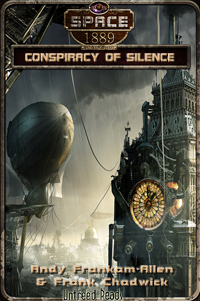
Conspiracy of Silence Reviewed by Steampunk Traveler


The Traveler's Steampunk Blog  reviewed Conspiracy of Silence (the first book in the second series of Space:1889 And Beyond ebooks from Untreed Reads, and co-authored by Andy Frankham-Allen and Yours Truely) last October, but for some reason it slipped by me. It's a very nice review, giving us ten out of ten Zeppelins and the Badge of Honor (editor's pick), which is about as good as it gets.


The reviewer believes it's the strongest of the Space: 1889 and Beyond books to date. I wouldn't want to compare it to other folks' work, but I think it's the strongest of the three books I worked on. Check it out. Here's the link to the review.

Thursday, March 21, 2013

How Dark The World Becomes -- now street-legal


Well, How Dark The World Becomes shipped in early February and is in Barnes & Nobles around the country as well as available through Amazon and directly from Baen Books, my publisher. I'm pretty excited. I already had a reading in Champaign, IL at the Iron Post (a great local jazz bar) and I have another one coming up on April 13 at the Jane Addams Book Store in Champaign, IL at 1:00 PM, as part of the Boneyard Arts Festival. Stop by if you're in the neighborhood. For than matter, I'm doing a book signing at the Champaign Barnes & Noble on Saturday, March 23rd at 1:00 PM as well. No reading, but stop by and say high if you happen to be in east-central Illinois around then. And as a writer friend of mine has said, "I wouldn't be offended if you bought a copy."

Here is the book back-copy:

An Addictive Taste of Freedom

Sasha Naradnyo is a gangster. He's a gangster with heart, sure, but Sasha sticks his neck out for no man. That's how you stay alive in Crack City, a colony stuffed deep into the crust of the otherwise unlivable planet Peezgtaan. Alive only -- because if you're human, you don't prosper, at least not for long. Sasha is a second generation City native. His parents came to this rock figuring to make it big, only to find that they'd been recruited as an indentured labor force for alien overlords known as the Varoki.

Now a pair of rich young Varoki under the care of a beautiful human nanny are fleeing Peezgtaan, and Sasha is recruited to help. He'd prefer to leave the little alien lordlings to their fate, but certain considerations -- such as Sasha's own imminent demise if he remains -- make it beneficial for him to take on the job.

Sasha discovers his simple choice has thrust him in the midst of a political battle that could remake the galactic balance of power and save humanity from slow death by servitude. Now all he has to do is survive and keep his charges alive on a hostile planet undergoing its own revolution.

But it's the galaxy that had better watch out. For now the toughest thug in Crack City has gotten his first taste of read freedom. He likes it, and he wants more.

***

If you've read it, please go on Amazon or Good Reads and review it. Good or bad, call it like you see it.

Here are some handy links.

Baen link to both the physical and e-book.

Amazon link to the physical book.

Amazon link to the Kindle e-book.

Monday, August 20, 2012

On Villains


It has been a while since I've done a craft-of-writing piece and since I'm struggling with the rewrite of The Forever Engine it seemed an appropriate time to share my thoughts on an issue which confronts (or ought to) all novelists -- their villain. There will be no spoilers in this piece, so no need to worry about that, but that also means it will address the broader issue of villains rather than the specific villain in The Forever Engine -- although the challenges are the same.

For starters, let me say that as a reader I have no patience with cardboard cutout villains, who are evil for evil's sake and whose principal motivation (that I can see) is to give the protagonist an excuse to whup up on the villain's legions of loyal minions. Why they are so loyal to this psycho is often a mystery worth considering, but that's usually the smallest problem I have with that sort of story.

For me, stories really work well when the villain is as  interesting as the protagonist -- maybe even more so. Think of how many really great stories were made great by the stature of their villains: Hannibal Lector in The Silence of the Lambs, Captain Ahab in Moby Dick, Iago in Othello, Dracula in Dracula, and for that matter Media in Media. So I see a four-fold challenge facing authors when it comes to their villains.


Challenge One: What do They Want?
Protagonists have over-arching goals. Villains do as well. What is their life goal? What end-state do they seek? Most importantly, why do they seek it? For their goal and motivation to be engaging it seems to me they have to see themselves as the heroes, the good guys. From their point of view, this is their story. I think the film Open Range is one of the five or ten best westerns of all time, and part of that is due to the villain (Denton Baxter) played by Michael Gambon. In a different story, perhaps one set a decade or two earlier and dealing with "taming the savage west," he'd be the hero. The fact that he's lived past his usefulness and has been unable or unwilling to adapt to changing times makes him definitely a bad guy, but one with some tragic aspects as well. How different is he from the protagonists of The Wild Bunch, or even Butch Cassidy and the Sundance Kid?


Challenge Two: What Do They Have To Do To Get What They Want?
This is a bit more mechanical than the above but still involves some artistry, as well as the need to tie the villain's actions into the genre. Ideally the villain's necessary actions should  be the window to the genre. In Open Range the villain's goals -- protect what's his -- manifest themselves in the struggle between fenced in pasturage and free-range cattle drives, and so show us an issue at the center of a turning point in the history of the west. In a science fiction story the villain's methods should be at the heart of the scientific curiosity of the story.


Challenge Three: Why Are The Villain's Actions So Potentially Catastrophic The Hero Must Stop Them At All Costs?
This is a tough one, but it becomes the heart of the story. It is the essence of the story's conflict and ultimately separates the hero from the villain. Since it's the heart of the novel, how big the conflict is determines the scope of the novel itself. If what's at stake is the hero's life, okay. We understand a person wants to survive in the face of a deadly threat, but that doesn't make them a hero, does it? That's not that big a story. Does the villain threaten other folks we care about? Bigger story. Does the villain threaten a way of life? Bigger story still. Is justice on the line? Is truth on the line? Will something of value to mankind be lost forever? These are bigger issues, and make the story itself bigger.

James Scott Bell defines a novel as "the story of how a character deals with the threat of death." The issue may be physical death but, as I noted above, that's often the least involving motivation for readers. But there are many forms of death. Professional death from failure in the character's chosen career. Emotional death from the loss of loved ones. Moral death from the betrayal of the character's core values. Spiritual death from the loss or abandonment of the character's defining principle or faith. Psychological death from the loss of sanity (see H. P. Lovecraft). Death of pride. Death of happiness. Death of hope. All are more involving than the simple issue of physical survival. What the villain threatens constitutes the stakes of the novel, and the bigger the stakes, the more engrossing the story.


Challenge Four: It All Has To Make Sense
This one, ironically, is the toughest of them all. A villain who has a giant organization working with him and whose goal is to destroy the world makes no sense. He's actually in the world. What does he get out of this deal? And yet you see this over and over. A human who betrays his race to alien exterminating conquerors "for power" makes no sense. Power over what? Power over whom? But you see this as well.


More subtly, the way the villain goes about achieving his goal has to be the most logical and sensible approach (at least for him). If he's going to set off an atomic bomb in New York City when he could as easily achieve his goal by robbing a convenient store, that's a problem.


There's a pretty good Denzel Washington film about a runaway train, called "Unstoppable." The villain is a senior executive at the railroad who will not listen to the voices of reason and experience and mishandles the attempts to solve the runaway train problem. But he isn't stupid; he's an experienced railroad man who's simply so used to being the smartest guy in the room he can't credit anyone's ideas but his own. So far so good.


So at one point he gets another engine in front of the runaway train to slow the train to the point that a replacement engineer can be lowered onto it from a helicopter. The train can't be slowed quite enough, the replacement engineer on the cable gets smashed through a window and seriously injured, and other bad things happen. It's a very dramatic and exciting sequence, but ruined (for me) by one nagging question: why not put the replacement engineer in the engine in front of the runaway train, so when they matched speeds and effectively coupled to it, he could just step from one engine walkway to the other? Remember, the villain isn't stupid, but in this case he is required to act as if he is simply so the story can go on. Not very satisfactory writing, in my opinion.


There are few things more annoying to me than a plot propelled forward primarily by the stupidity of the villain, unless (as in the film Fargo) that's kind of the point of the story. So the hardest part of all this, in my opinion, is making all these moving parts fit together as if this is the only way in the world they possibly could. If you can pull that off, that is good writing.

Thursday, June 7, 2012

A Legendary Writer Passes


By now, I imagine all of you have heard that Ray Bradbury passed on June 5. He would have been 92 this coming August. Honestly, there is not a single person on the planet who reads science fiction, writes it, or watches it on television, film, or in video games, whose life was not touched by Bradbury, and for the better. The New York Times credits him with bringing science fiction into the literary mainstream, and I think they are absolutely right. Although the Bradbury book which made the strongest impression on me at first was The Martian Chronicles, I think the one which left a more lasting memory was Something Wicked This Way Comes. It taught me that prose -- even fantasy and science fiction -- can be lyrical, that how you say something often communicates your meaning far better than what you say.

It's strange that just a few days ago I was writing about Edgar Rice Burroughs, certainly my favorite author as a youngster. Now I discover (I hadn't know this before) that ERB was Bradbury's favorite author as a youngster as well. What does ERB's prose have in common with Bradbury's? Nothing that I can see, aside from each writer having a powerful sense of adventure. I suppose that shows a talent like Bradbury's can draw inspiration from a source without ever simply imitating it. I also discovered Bradbury was a life-long friend of the film maker and special effects genius Ray Harryhausen, another big, big influence in my young life. No wonder I liked so much of Bradbury's writing.

Rest in peace, Ray.

Monday, May 14, 2012

Space 1889 Novel to be Published by Baen Books

Yesterday I promised you some big news and here it is.

I told you several months ago that Baen Books was publishing my novel How Dark The World Becomes. When they contracted for that book they asked if I had anything else for them to look at. I did: The Forever Engine, a Space: 1889 novel. I sent it off, we've talked several times since then, and Friday I signed the contracts and dropped them in the mail. A Space: 1889 novel will see print in the near future from one of the top science fiction publishers.

I don't have a release date yet. I'm working on some rewrites and once those are locked down to everyone's satisfaction Baen will come up with a date. But in the mean time this is very exciting stuff for me.

The novel actually takes place in 1888 and some of the events and characters from The Forever Engine appear as background incidents and minor characters in one (so far) of the Space: 1889 and Beyond stories. But it's not a prequill or a lead-in to other stories. It's a great big story which stands all on its own, and deals with nothing less than the fundamental fabric of the universe.

I can't tell you much more about it now. As we get closer I'll lay some groundwork, but right now publication is well over a year away, so everyne gets to work on refining the virtue of patience.

Sunday, May 13, 2012

Great Review of A Prince of Mars!


I just got a great review of A Prince of Mars from the Traveler's Steampunk Blog. Ten out of ten zeppelins! He was very careful to touch on some of the critical features of the story without letting any spoilers slip, which I really appreciate. Those of you who have read it know there are some pretty sharp twists and turns and a place where, if I've done my job right, the readers will smack their foreheads and say, "Oh! Of course!" So I'm glad he didn't let any cats out of the properly-ventilated pet carrier.

Here's a link to the review.

I'd have held off on this announcement until tomorrow, but I promised you big news then and I didn't want to step on that story with this one -- not that this one isn't way-cool.

Wednesday, April 25, 2012

Dark Side of Luna is Live!


Yes indeed, Dark Side of Luna, the sixth and final installment in Series One of Space 1889 and Beyond, is now live. It is available from the Untreed Reads online store, Amazon, Scribd, OmniLit.com, Barnes and Noble, and Lightning Source. As always I encourage you to purchase it directly from the Untreed Reads online store as the publisher and authors both get a bigger piece of the action, and of course in this case I am one of those.

The next book, which starts Series Twio but picks up right where Dark Side leaves off, is co-authored any Andy Frankham-Allen and myself, and it's a real plunge into the seamier sides of London and international politics. But that's a different matter. For now, enjoy Dark Side of Luna.


Description:
It’s been almost a month since Nathanial and Annabelle rejoined HMAS Sovereign. For Annabelle it’s been a journey of uncertainty; she had expected a happy reunion with George Bedford, first officer of the flagship of Her Majesty’s Royal Navy, but instead he’s been distant. She fears it has something to do with her newfound disability. For Nathanial, however, the journey has been uneventful since he’s spent the entire time locked in the brig under the cloud of treason.

Things change abruptly when Sovereign is ordered to return to Luna, and retrieve Doctor Cyrus Grant, who has been sending increasingly confusing heliograph messages back to Earth. There is an air of uncertainty in Otterbein Base, and concern over Grant’s well-being. Once again he’s gone missing, turning his back on the Selenites and the British research team stationed there – leaving with creatures who are neither human nor Selenite.

A search-and-rescue mission is soon underway, taking our heroes deeper inside Luna than ever before. There they will discover the mysteries of the Drobates, and their amazing City of Light and Science. Annabelle is concerned that her uncle will no longer accept her, and Bedford is concerned that being on Luna once again will have adverse effects on his captain, but these things are the least of their worries. Grant is close to uncovering the answers to an age-old secret, but he is not the only one who seeks this knowledge. A creature stalks the dark underworld of Luna, a creature once human, and quite insane.

Dark Side of Luna is the series one finale of Space: 1889 & Beyond, and signals a new era of political upheaval and adventure for the series, as the key to humanity’s future is unveiled.

Excerpt:

BEDFORD LOOKED out of the thick glass of the cutter’s forward lower viewing port and shook his head. He expected robust security at the landing ground of Otterbein Base, but he had not counted on a mob of turbaned and khaki-clad Indian Army men swarming over the area.

“Have a care, Coxswain. Let’s not crush any sowars today when we set down,” he said and the helmsman smiled slightly in reply. The cutter settled gently to the gravel landing ground and had scarcely come to rest when Bedford heard an insistent banging on the main hatch. A Marine corporal undogged the hatch and swung it to the side to show a European of medium height and swarthy complexion in khaki drill and an officer’s Sam Brown belt, but no badges of rank on his bush jacket.

“Who’s that and what’s your purpose?” the man demanded.

“I am Lieutenant Bedford of HMAS Sovereign, and I’m here to see Captain Folkard.”

The man nodded. “Harrison, Punjab Frontier Force, and officer commanding, Otterbein Station.”

“Ah, Colonel Harrison, of course. I did not expect the commanding officer to meet us, sir.”

“Didn’t intend to. We’ve suffered a security breach. Regrettable. Losses, you know, losses all around.”

“Losses all around?” Bedford asked, and he felt his heart accelerate. “The young lady in the party was not…”

“What? There’s a lady down here, too? Damn me if I can keep track. But no, it’s your young officer, Ainsworth. Identified him from his papers. Sorry, one of those damned ants got him. Chopped him up rather badly. Care to look? No? Just as well. Private Anil Singh suffered the same fate. Ghastly. Good chap, Singh. Why’d your people take the cutter away and leave this Ainsworth behind alone, eh?”

“Our people did not take the cutter. The Selenites, probably the ones who attacked him, did. Five of them, with Russian-made Berdans. They took the cutter up and attacked Sovereign.”

“What’s that? Ants with Berdans? Well then, where are your people?”

Bedford stifled an exasperated sigh. “They are still here, Colonel. As I said, I came here to find my captain. I take it you haven’t seen him?”

Harrison looked around, as if he might find the others from Sovereign standing within arm’s reach, then he looked back at Bedford, his expression a mixture of irritation and confusion. “Well damn it, man, if they’re still here, who flew your cutter full of ants away?”

“One of the Selenites, I imagine, as only they were on board when they docked with us.” Bedford no longer kept the sarcasm from his voice, but it was lost on Harrison, as a good deal else seemed to be as well. Bedford caught a faint odour of gin on the colonel’s breath.

“What? No. Ants can’t fly one of those cutters. I’ve never seen one at any rate,” Harrison declared and then nodded forcefully, as if that settled everything.

Bedford judged Harrison the sort of man who considered the absolute boundaries of possibility to be the things he had actually witnessed with his own eyes. Bedford thought that made Harrison a singularly bad choice for lunar duty. Well, that was the Army for you.

“I wonder, Colonel, if you could have your men clear enough of the landing ground for my coxswains to bring the other three cutters down? One of the men is new to his job and I wouldn’t want him to injure any of your sowars.”

Harrison turned away to clear his men off the field as another man, of slighter build and in a suit coat instead of khaki, trotted up from the direction of the main building. He paused for a moment to catch his breath and mop his brow with a handkerchief, and then extended his hand.

“Professor Robert George, director of the base,” he said. Bedford shook his hand and introduced himself and again asked after the landing party.

“Captain Folkard and his men, and Doctor Grant’s niece, have gone in pursuit of Grant. Three Selenites accompanied them. They have been gone some hours, I know not in what direction.”

“You do not think they have approached the Heart?”

“The Heart is made up of many parts, Lieutenant. Colonel Harrison has posted guard details at those nearby parts we know of, but I doubt any man, even Grant, knows where every piece of the Heart is located.”

Bedford frowned. He hadn’t really expected to find Folkard and the others here at the base, but he had hoped for more useful intelligence than this. The Marines poured out the open hatchways of the cutters and now formed a double line on the gravel landing ground, barked into place by their colour sergeant. Major Larkins and his vice, Lieutenant Booth, joined Bedford and Director George.

“Ships troops assembled and ready,” Larkins said casually after Bedford made the introductions. “Your orders, Lieutenant?”

Bedford noted that Larkin stopped short of calling him “sir”. Larkins outranked Bedford, but as a Marine officer he was not in the ship’s chain of command, and so long as he was assigned to Sovereign, he obeyed its master. It may have rankled him to take orders from someone this junior to him, but that was the Navy for you. Colonel Harrison wandered back to join the group and Bedford used the opportunity of another round of introductions to think through what his next move should be.

“Colonel Harrison,” he said, “I believe the Berdan rifles suggest a continued Russian presence on Luna. Someone armed those red Selenites, someone taught them how to use a breach-loading rifle…”

“Not very well, I shouldn’t think, or you wouldn’t be standing here now,” Major Larkins put in.

“Thank you, Major, that may be true. But the fact remains someone did arm and train them, however inadequately, and most importantly someone taught one of them to fly a cutter equipped with a Grant-Stone-pattern aether propeller governor.”

“Oh, I see,” Director George said and mopped his brow again. “That is quite extraordinary. I should like to have seen the Selenite pilot your craft. I would not have thought they had the forelimb manual dexterity to do so.”

“Nevertheless,” Bedford said.

“Well I still don’t believe it,” Harrison grumbled. “Oh, the Russkies are probably behind it all, you’re right on the score, but I warrant some tsarist hero piloted the ants to your ship and jumped clear immediately before they docked, just to throw us off the scent.”

“How would he have survived?” Director George asked.

“Survived? How does that enter into it? Those chaps don’t put the same value on human life we do,” Harrison said.

Major Larkins looked at Harrison and then at Bedford. Bedford met his eyes and, though neither man’s expression changed, they understood each other: Harrison was a fool.

“It’s still very odd, though,” Harrison continued. “I haven’t seen evidence of Russians in this part of Luna for quite some time. Indeed, the only relic of their occupation left is the wreck of their flyer Borodino, on the opposite side of the reservoir.”

Bedford narrowed his eyes. “Take me there.”

Monday, April 16, 2012

Dark Side of Luna -- Coming This Week


Book six, and the finale to the first season of Space 1889 and Beyond stories, will be out from Untreed Reads by the end of this week. The finished cover is above and it has a suitably menacing look to it. I co-authored this piece and I think you'll really like it. Dark Side of Luna has lots of action, including a sort of "small war" military campaign (if you can conduct an extended campaign with one section of Royal Marine Light Infantry -- and it seems you can if you are a sufficiently determined and resourceful chap).

So those of you who have purchased A Prince of Mars but not yet read it might want to, so as to be primed for this new epic adventure. Those of you who have not purchased it . . . well, I hardly know what to offer you other than a revolver and some privacy.

Andy Frankham-Allen , the series editor, and I are co-authoring the lead book in the second series, Conspiracy of Silence, which picks up where Dark Side of Luna leaves off. In fact, I've got to finish up the last chapter, so back to it.

Tuesday, March 20, 2012

Back From The Road

I'm back at the keyboard after a long absence. I attended the Cold Wars game show in Lancaster PA on the 9th through the 11th and then stayed over and attended The Write Stuff writers' conference in Allentown PA on the 16th and 17th.

I got to hang out with my goddaughter Diana for a few days in between -- she's 13 months now and a real pistol. She's got about a dozen words and came up with a new phrase while I was there. She waved and said "night-night!" to me one night, the first time she's ever said that. She has one other phrase she's fond of as well: "oh-shit!"

Just look at those eyes, would ya? Those of you who have picked up A Prince of Mars may have noticed it's dedicated to her, "when she's old enough to read it." Maybe not as long as I thought.

The Write Stuff is sponsored by my old writers' group, the Greater Lehigh Valley Writers' Group (GLVWG, pronounced Gliv-Wig), and it's probably the best small writer's conference out there. They cap the attendance at 150 (because of the venue) but always manage to get great presenters. James Scott Bell was the featured guest this year, did a two-day workshop before the show, several presentations during it, and the keynote address. Bell's been a hero of mine for a long time. He's not just a fine writer, he's written probably the most practical and useful book on writing I've ever read: Plot and Structure, published by Writer's Digest Books. If you are interested in writing, buy this book. Buy it now.

His workshop was loaded with terrific material as well, and I'll share just one bit which was actually almost an aside, and wasn't part of his main syllabus, but is worth repeating. It has to do with elevator pitches. For those of you who aren't professional writers, or aspiring professional writers, the "elevator pitch" is designed for those moments at a writer's conference (and they are way more common than you would think) when you get in an elevator, the doors slide shut, the person standing next to you notices your badge and says, "I'm a literary agent (or acquisitions editor). I see you're attending the conference too. What are you working on?" You now have less than a minute to "pitch" your book. Tou have to say everything necessary not only to explain what the book is about, but also hook the interest of someone who has already heard probably twenty pitches so far that day. If you start with, "Well, it's complicated. . ." hang it up. Either you know exactly what's coming out of your mouth or you don't.

So what Bell gave us was his take on the classic elevator pitch. He argues the pitch consists of three sentences. The first one gives the character's name, occupation, and everything you need to know about their background. "Dorothy is a young girl in rural Kansas, unsatisfied with the dull world in which she lives." The second sentence begins with the word "When," and establishes the inciting event which catapults the character into the main part of the story. "When a tornado picks her up and lands her in Oz, she finds herself the target of a Wicked Witch." The third sentence starts with the word "Now" and explains the main object and conflict in the novel. "Now, with the help of three unlikely companions, she must make her way to the Emerald City so the Wizard can show her the way home."

Why, aside from helping you sell your book, is this so important? Because it also helps you understand your story. One of the guys at the conference later told me he couldn't really fit his story into these three sentences, and that told him he had a story problem. He did not have a clear enough inciting event and he really didn't know what the main objective of his protagonist was. He'd had the feeling something was wrong with the story for some time; now he knew what it was and how to fix it.

Also later in the conference I had a meeting with an agent interested in steampunk fiction. My own The Forever Engine is currently in at Baen Books under option, although I havn't heard yet whether they are going to pick it up. I told her that and that it might not be available but she wanted to hear about it anyway. (Already having another book under contract doesn't hurt.) So here's what I told her:

"Nick Fargo is an historian at the University of Chicago and an Army veteran of Afghanistan, When he is called to England to help investigate an odd cultural resource find at a high energy particle accelerator facility, a catastrophic accident hurls him back in time and into a parallel Victorian world, where there are flying ironclads and interplanetary travel is a reality. Now, joining forces with the British military and a beautiful French spy, he must track down a murderous rogue scientist who may hold the key to his return to his own time and place."

We had more than a minute to talk, but this got her interested. She asked about the protagonist and liked what I told her, because it was different than what she expected. She asked about the heroine and was even more interested, again because what I said wasn't what she expected. She asked about the outcome of the story and liked that as well, because, again, it surprised her. So she asked to see the book, even knowing it might not be available, and I sent it off today.

There are two lessons in this.

First, you have to have a clear and very simple understanding of your protagonist and his or her story in order to engage the interest of readers. (In this case, the agent represents all readers, because she is looking for things which her experience tells her will interest a large number of readers.)

Second, at every step of her follow-on questions, she liked what she heard because it was not what she expected. There are tens of thousands of stories appearing in print and as ebooks each year. The object for a writer is not to fit in, it is to stand out. Readers are not interested in reading the same things they have already read, but rather something different, surprising, even shocking. If you want to tell stories,
those are the stories worth telling.

For those of you interested (and strategically located) Bell is doing a number of multi-day workshops across the country this year. Check him out at this link and then click on the "The Seminar" button.

Monday, February 27, 2012

Prince of Mars is Live!

A Prince of Mars is live at last! Those of you who have pre-purchased the series should already have your downloads. The rest of you can pick it up from any of these online sites:

The Untreed Reads Store (http://bit.ly/xOVH8R)
Amazon
Scribd
OmniLit.com
Barnes and Noble
Lightning Source


Here is the publisher's description:

Barely making it to Mars in their crippled aether cutter, Nathanial and Annabelle crash in the desolate Martian wastes. A disfigured Martian with a mysterious past helps them survive in the desert, but when they are rescued by a passing caravan their troubles may only have started.

Raids by steppe nomads and flying skrill riders are the most obvious dangers, but simmering resentment against Earth humans, and intricate plots to overthrow the British colony, lurk everywhere just beneath the surface.

Apparent friends become enemies, unexpected allies appear from unlikely sources, and the shadowy past of their Martian guardian collides with the sinister plans of the murderous head of the dreaded Martian Cult of the Worm...


And here is an excerpt to tease your interest:

Nathanial thirsted, but he did not trust his trembling hands to pick up the water cup without splashing half its contents on the sand. They were not short of water, of course. He simply was loathe to show weakness in front of Kak’hamish.

“You have pen and paper,” Kak’hamish said. “I will write out an explanation of your situation in Koline. All caravan masters speak Koline—it is a trade language, a pidgin of several tongues. If you are fortunate, the first caravan we see will be heading northwest, to Abak’hn. That is where you need to start. Then you must take a caravan or cloudship southwest to Siruahn, then another southwest to Thoth. Thoth is on the Grand Canal. From there you can obtain passage on a boat south to Shastapsh, where I hear there is a British garrison.”

“You will not accompany us any farther?”

“I have…other plans.”

Rubbish! The fellow had no plans other than to wander back into the desert to die. If Nathanial had been by himself it might have been different. He could take care of himself, steal food if he had to, barter for passage using the instruments and valuables he had brought off the cutter. But with Annabelle in the state she was in, he wasn’t sure how he would manage. Much as he hated to admit it, this scoundrel could help.

“You might at least tell me something of these cities we’re to pass through. Are they dangerous?”

Kak’hamish moved his jaw from side to side in thought. Clack-clack. “Dangerous? All cities are dangerous to one degree or another, aren’t they? People live in cities so…well, there you are.

“Abak’hn I suppose is particularly dangerous in that manner, although I have not been there for many years and it may have improved. Or deteriorated. It is cursed with a weak prince, Akhanoon III. He is absorbed by his own pleasures and content to let the city govern itself.”

“Some would say the hand of government lying lightly is a blessing,” Nathanial said.

“Yes, I have heard this as well but never from one who has actually experienced it first-hand, unless they were very rich. Without a patron or protector, you will be in considerable peril in Abak’hn. The strong take what they want and the town watch looks the other way, unless disorder threatens commerce or offends the sensibilities of the gentry—so there is sometimes danger in resisting the predators as well.”

“Sounds like a rum place,” Nathanial observed, and he admitted to a pang of anxiety. He was armed, it was true, but he had no confidence in his own abilities in a violent confrontation. True, he’d shot Le Boeuf, a cold and considered act for what Le Boeuf had done to Annabelle. But still, thinking back, it almost seemed as if another man had pulled the trigger, not him at all. He had hardly had cause to even raise his voice to someone before embarking on this disastrous tour of the worlds. Since then, often as not it had been Annabelle who had taken the lead, charted a plan of action. Poor Annabelle! Still half out of her head with fever. He wished she would recover quickly. He desperately needed her clear head, courage, and decisive nature.

The truth was he simply didn’t feel up to facing this by himself. If it came to that, could he kill a man? Well, yes. He had done it once and felt no regrets on that score. He could do it again, if necessary. But that was a devil he knew. What of the devils he knew not? Too many ill-understood dangers, and too many ambiguous situations requiring decisions on little or no reliable information, blocked the way forward. One had to trust one’s instincts, he supposed, and just forge ahead. But what if one had little faith in those instincts?

Kak’hamish was talking again and Nathanial shook those maudlin thoughts from his head.

“Siruahn is very different, of course. It once had a young prince like Akhanoon—stupid, vain, and convinced of his own indispensability. This was a conviction the people of Siruahn did not share. Twenty-some years ago they drove him out and turned the government over to a council elected from the different castes—merchants, tradesmen, farmers—even labourers, as I recall, although the wealthy are better represented than their numbers might warrant.”

“Really? It sounds a bit like a parliament,” Nathanial said. “How are they chosen, by election?”

Clack-clack. “I do not know exactly. Someone once told me, but it was very complicated and I have forgotten most of it. I understand they argue about the selection a great deal and make frequent changes, so it would be different now in any case. They argue about everything, I have heard. The poor argue with the rich, and are not even beaten for their insolence! It has become a very argumentative city.” Kak’hamish shook his head as if in disapproval, but Nathanial noticed he smiled as he did so. It was hard to tell a smile from a grimace on Kak’hamish unless you looked at his eyes. “This was a distressful business with Miss Annabelle’s wound,” Kak’hamish said. “It grows late and distress can bring fatigue. We should sleep, but also take turns watching. You still have your pistol?”

“Yes, it’s in my kit over there. Do you think we need it? I thought there were no large predators out here.”

“Not in the deadlands, but we no longer sleep in their sandy embrace. There is much to sustain a predator in the gardenways—now including us. Some of the larger animals have developed a taste for stragglers from caravans. They may like the taste of Earth people less than my own folk, but by the time they discover that it will do you no good.”

Nathanial tried not to look as if he was hurrying as he walked to the travois to get his derringer. That box of extra cartridges wouldn’t hurt either, come to think of it. Sometimes animals ran in packs, after all.

Monday, February 20, 2012

Interview at the Traveler Steampunk Blog

As A Prince of Mars will be released any day now, the Traveller Steampunk Blog just released an interview I did a little while ago. It touches on a lot of stuff, but almost all of it is related to Space: 1889. Here's the link.