Showing posts with label Frank Chadwick. Show all posts

Saturday, March 29, 2014

Another Nice Review of How Dark The World Becomes


Here is a link to a nice review of How Dark the World Becomes from Astro Guyz, the science (with a heavy emphasis on astronomy) and science fiction blog by David Dickinson. This review hit last year but for some reason I missed it until just now. I like the fact that he picks up on the book's unique (or at least uncommon) treatment of humans in a multi-species confederation, i.e. we're on the bottom instead of the top.

Thursday, March 20, 2014

The Contest With No Prizes -- Lucky Winners Announced

Alas, there are no lucky winners. No one took me up on my generous offer of no prizes for figuring out the three word plays embedded in the short story "Murder on the Hochflieger Ost." For the curious, here are the answers.

You may recall that I said there were three embedded word plays. One involved an artifact, which I though everyone would get. One involved a location, which I thought would be harder. The last one, involving a character's name, I though would be all but impossible.

The Artifact
When explaining why the plans of the aether battleship are of no use to the French, Renfrew explains that they do not include the plans for the analytic engine which makes the ship so powerful. The analytic engine in question is the Improved Babbage, Model Three Hundred and Sixty.

IBM-360? Nobody caught that? Really?

The Location
Gabrielle's false business card lists the address of her appraisal firm as 13 Rue Madeleine, Le Havre, France. In the 1947 James Cagney World War II espionage film 13 Rue Madeleine, that is the address of Gestapo headquarters in Le Havre.  

The Name
Etienne Villon thinks of Gabrielle Courbiere as having the strength and majesty of a mountain, and when he thinks of her as Mont Courbiere he likes the sound of the name.

Francois Villon is probably the best-remembered French poet of the late middle ages, known probably as much for his remarkably adventurous life as for his writing, and his life formed the inspiration for Bertold Brecht's "Baal" and "Threepenny Opera," the Friml operetta "The Vagabond King", and the novel, play and film "If I Were King." Villon's birth name was probably Francois de Montcorbier.

He liked to sprinkle his poems with hidden jokes.
 

Saturday, January 18, 2014

A Nice Review of "How Dark The World Becomes"

I've been pleased with the reception of How Dark The World Becomes. It's gotten a solid 4.6 stars on Amazon, with only a single three-star review and all the rest fours and fives. It hasn't gotten a lot of published reviews, however, so I was glad to see the SFcrowsnest site in the UK post a nice review last month. Here's a link.

I'm pleased by the review not only because it's positive, but particularly because the reviewer, Kelly Jensen, finds the strengths of the story to lie above all in its characters and world building, which are two of the three parts of the novel I like most and worked hardest on.

For those curious, the third part (for me) was pacing.

On January 9th I also got a short but nice review in  the Philadelphia Weekly Press from Henry Lazarus. "Very exciting," the review claims (in part--it's not that short). I guess he noticed the attention to pacing.

Tuesday, January 7, 2014

The Forever Engine is Live!

Today's the first official day when The Forever Engine is live. Amazon has been shipping the advanced orders and is now posting reviews.(First one's up--four stars and a very nice write-up.) It should be in the stores as well, although I haven't yet braved "The Killer Storm of the Century" to find out if it's in my local Barnes & Noble.

Although the ratings change hourly, last time I looked the book was at number 13 for both time travel science fiction and steampunk on the Amazon best-seller lists, and that's mostly based on preorders. I don't really understand how those rankings work (and they make a point of telling you they will not reveal how they come up with them, I suppose so folks can't game the system) but since the sample size is over a million total book-like products, whatever 13th means, it can't suck.

Of course the book's been trickling out for a number of weeks. The Baen Books eArc (electronic advanced reading copy) was available a while ago and I've heard from folks that Amazon went ahead and sent the Kindle versions upon ordering starting sometime  in December, and we're right at a point in the History of Book-like Things where the electronic version approaches the importance of the physical product. We've certainly passed it for some forms of Book-like Things.

Those of you in the Midwest and east coast: stay warm. Maybe curl up with a good book.

Friday, January 3, 2014

Happy New Year!

Happy New Year one and all! 2013 was a busy year for me, and a very good one. I have a number of resolutions for the new year, one of which concerns this blog. I'll leave what that resolution might be to your collective imaginations.


The immediate news is that The Forever Engine will be on the shelves in bookstores within the next week, and also available in all e-formats from Baen Books (here's a link to their site) and also available online in paper and Kindle versions from Amazon. I received a very nice advanced review in Publishers Weekly back in the November 4th issue. Here's what it said, in part, with potential spoilers left out:

"Legendary game designer Chadwick taps into his popular Space: 1889 steampunk setting with this exciting prequel novel, which sees soldier-turned-historian Jack Fargo catapulted from 2018 to an alternate 1888 by a mysterious explosive event. Although alternately amazed and baffled by a world that features airships, interplanetary travel, America split into the Confederate States and the United States, and Europe laid out along different political lines, Fargo just wants to go home. . . .(T)he world building is rock solid, the plot fast paced, the action visceral, and the stakes high. Chadwick balances scientific theory, steampunk imagery, and memorable characters with flair. . . "

I blush.

Relating to the novel, Baen Books (my publisher) and I also have a New Year's present for you. They contracted a short story from me as a prequel to the novel and as a way of giving a little more background on one of the characters. The story is called, "Murder on the Hochflieger Ost," and takes place a year before the events of the novel on an enormous luxury zeppelin plying the Berlin-to-Istanbul route--the Space: 1889 equivalent of the Orient Express. It's a free download at the Baen Books site. Just click on this link.

Tony Daniels, my editor at Baen Books and a fine writer in his own right, had some great ideas for the rewrite and nudged me toward a far better final resolution, in my opinion. A book ends up being a collaborative effort and much of the success stems from the help the author receives from others. It still ultimately comes down to the author, but I think the current trend toward self-publishing risks losing some of the collaborative effect of going through a publishing house. Yes, you can hire editors and proofreaders, but I'm not sure it's quite the same thing. Nevertheless, it's certainly here to stay, and will certainly become an increasing part of the literary scene. The economics of publishing almost dictates it for most writers. Who knows what the future will bring, but I'm happy to be with a publishing house like Baen, one that's still intimately connected to their authors and to their customers.
 

Saturday, March 23, 2013

Forever Engine - A Map of Europe


Baen Books commissioned this map of western Europe in 1888 as a two-page spread in The Forever Engine, due out next January. I like what they did with it, particularly the gears for cities and towns. It covers the area where the action of the novel takes place and from some of the unlikely smaller locations included, you can probably figure out that some of the important action takes place in out-of-the-way places like Kokin Brod. You get a nice look at London and Munich as well, however.

They've also commissioned cover art well in advance and may end up with some interior art as well, so I'm very pleased with the care they're taking with the project. It's not too soon to start some buzz about this book. If it sells well, I can pretty much guarrantee sequels. When we get a little closer to publication, I'll post some sample passages here. As soon as I get the go-ahead from Baen (which I think will mean as soon as they are happy with it) I'll post the cover. Cool cover.

Sunday, December 9, 2012

Mars Needs Steam Pictures From Celesticon


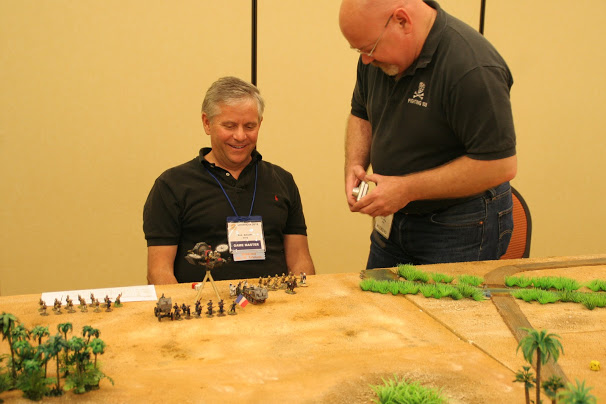
I attended Celesticon out the San Francisco area last Labor Day and ran a big Mars Needs Steam game. Rick Schutz provided the terrain and soldiers while I shipped out an assortment of special stuff -- unique units and steampunk vehicles -- to flesh out the game. You've seen lots of pictures of the game with our terrain, mostly built by Glenn Kidd. Here's a look at what you can do with terrain originally intended for historical games. I envisioned this as a ground near a "broken canal," the sort where the channel itself has shattered and the water has spread out to make a shallow lake and swamp. Beyond it is arrid ground.


Heres another view. I'm explaining the rules and Rick sits to my right. These photos were all taken by Kyle Talbert, who did a great job. It's definitely a different look from most of our games, but a very nice one. The important thing, in my view, is that the table be well broken up into discrete areas so it remains possible to move and maneuver. Otherwise games (this one or most others involving a fair number of long-ranged weapons) are likely to degenerate into long-range sniping contests.


One of the great things about the show is that Dave Nilsen, an old friend from GDW days and maybe the best game designer/developer I ever worked with, showed up at the show. He pitched in and helped run the game as well as push some troops. Here's Rick seated and Dave standing, with the French contingent in front of them.


Here the French aerothopter is about to strafe the British Colonial contingent from behind. Tres ignoble, n'est pas? Rick's Indian infantry in the lead are supported by Tom Harris's dismounted female hussars representing Canadian "Amazonians."


Here's a different view of the British Colonial contingent from the other direction. You can see the Indian infantry in the background and the Amazonians, while in the foreground Bengal lancers cross a wadi supported by a light scouting landship. 

All in all, we had a great time.


Saturday, December 1, 2012

Cover Art For Mars Needs Steam


You may recall I mentioned earlier that we'd contracted for a cover for Mars Needs Steam from Talon Dunning. The first version wasn't really to any of our liking (including Talon's) and so we went back to the drawing board and I'm glad we did. This time Talon nailed it! This really captures the feel of the game and will be a great cover. Now all I have to do is finish the final rewrite of the rules and we're on the way to publication.

I just returned from running a big game up in the Illinois-Wisconsin border area for Anderson's Irregulars, a great bunch of gamers honchoed by Mark Anderson and which includes my old pal Duke Seifried. Duke's approach to "adventure games" informs a lot of the encounter rules in the Mars Needs Steam game as well as generally moving it past a simple soldier game, so seeing him have a good time was fun. His Germans were all but destroyed by the French and Americans, but not before gutting both of those contingents so thoroughly that when the Japanese switched sides they were able to forge on to victory.

I'm very happy with how the game plays now, after dozens of playings with who knows how many players -- most of them first-timers. The rewrite I'm working on is just to smooth out any remaining rule ambiguities and add a few more exotic weapons to the design system.

Monday, August 20, 2012

On Villains


It has been a while since I've done a craft-of-writing piece and since I'm struggling with the rewrite of The Forever Engine it seemed an appropriate time to share my thoughts on an issue which confronts (or ought to) all novelists -- their villain. There will be no spoilers in this piece, so no need to worry about that, but that also means it will address the broader issue of villains rather than the specific villain in The Forever Engine -- although the challenges are the same.

For starters, let me say that as a reader I have no patience with cardboard cutout villains, who are evil for evil's sake and whose principal motivation (that I can see) is to give the protagonist an excuse to whup up on the villain's legions of loyal minions. Why they are so loyal to this psycho is often a mystery worth considering, but that's usually the smallest problem I have with that sort of story.

For me, stories really work well when the villain is as  interesting as the protagonist -- maybe even more so. Think of how many really great stories were made great by the stature of their villains: Hannibal Lector in The Silence of the Lambs, Captain Ahab in Moby Dick, Iago in Othello, Dracula in Dracula, and for that matter Media in Media. So I see a four-fold challenge facing authors when it comes to their villains.


Challenge One: What do They Want?
Protagonists have over-arching goals. Villains do as well. What is their life goal? What end-state do they seek? Most importantly, why do they seek it? For their goal and motivation to be engaging it seems to me they have to see themselves as the heroes, the good guys. From their point of view, this is their story. I think the film Open Range is one of the five or ten best westerns of all time, and part of that is due to the villain (Denton Baxter) played by Michael Gambon. In a different story, perhaps one set a decade or two earlier and dealing with "taming the savage west," he'd be the hero. The fact that he's lived past his usefulness and has been unable or unwilling to adapt to changing times makes him definitely a bad guy, but one with some tragic aspects as well. How different is he from the protagonists of The Wild Bunch, or even Butch Cassidy and the Sundance Kid?


Challenge Two: What Do They Have To Do To Get What They Want?
This is a bit more mechanical than the above but still involves some artistry, as well as the need to tie the villain's actions into the genre. Ideally the villain's necessary actions should  be the window to the genre. In Open Range the villain's goals -- protect what's his -- manifest themselves in the struggle between fenced in pasturage and free-range cattle drives, and so show us an issue at the center of a turning point in the history of the west. In a science fiction story the villain's methods should be at the heart of the scientific curiosity of the story.


Challenge Three: Why Are The Villain's Actions So Potentially Catastrophic The Hero Must Stop Them At All Costs?
This is a tough one, but it becomes the heart of the story. It is the essence of the story's conflict and ultimately separates the hero from the villain. Since it's the heart of the novel, how big the conflict is determines the scope of the novel itself. If what's at stake is the hero's life, okay. We understand a person wants to survive in the face of a deadly threat, but that doesn't make them a hero, does it? That's not that big a story. Does the villain threaten other folks we care about? Bigger story. Does the villain threaten a way of life? Bigger story still. Is justice on the line? Is truth on the line? Will something of value to mankind be lost forever? These are bigger issues, and make the story itself bigger.

James Scott Bell defines a novel as "the story of how a character deals with the threat of death." The issue may be physical death but, as I noted above, that's often the least involving motivation for readers. But there are many forms of death. Professional death from failure in the character's chosen career. Emotional death from the loss of loved ones. Moral death from the betrayal of the character's core values. Spiritual death from the loss or abandonment of the character's defining principle or faith. Psychological death from the loss of sanity (see H. P. Lovecraft). Death of pride. Death of happiness. Death of hope. All are more involving than the simple issue of physical survival. What the villain threatens constitutes the stakes of the novel, and the bigger the stakes, the more engrossing the story.


Challenge Four: It All Has To Make Sense
This one, ironically, is the toughest of them all. A villain who has a giant organization working with him and whose goal is to destroy the world makes no sense. He's actually in the world. What does he get out of this deal? And yet you see this over and over. A human who betrays his race to alien exterminating conquerors "for power" makes no sense. Power over what? Power over whom? But you see this as well.


More subtly, the way the villain goes about achieving his goal has to be the most logical and sensible approach (at least for him). If he's going to set off an atomic bomb in New York City when he could as easily achieve his goal by robbing a convenient store, that's a problem.


There's a pretty good Denzel Washington film about a runaway train, called "Unstoppable." The villain is a senior executive at the railroad who will not listen to the voices of reason and experience and mishandles the attempts to solve the runaway train problem. But he isn't stupid; he's an experienced railroad man who's simply so used to being the smartest guy in the room he can't credit anyone's ideas but his own. So far so good.


So at one point he gets another engine in front of the runaway train to slow the train to the point that a replacement engineer can be lowered onto it from a helicopter. The train can't be slowed quite enough, the replacement engineer on the cable gets smashed through a window and seriously injured, and other bad things happen. It's a very dramatic and exciting sequence, but ruined (for me) by one nagging question: why not put the replacement engineer in the engine in front of the runaway train, so when they matched speeds and effectively coupled to it, he could just step from one engine walkway to the other? Remember, the villain isn't stupid, but in this case he is required to act as if he is simply so the story can go on. Not very satisfactory writing, in my opinion.


There are few things more annoying to me than a plot propelled forward primarily by the stupidity of the villain, unless (as in the film Fargo) that's kind of the point of the story. So the hardest part of all this, in my opinion, is making all these moving parts fit together as if this is the only way in the world they possibly could. If you can pull that off, that is good writing.

Saturday, August 18, 2012

The Brits Are Here From Highlander Studios


Rod of Highlander Studios released his first British 15mm Space: 1889 infantry at Historicon, the British Firing Line. As nice as his personality figures are, the bulk of the figures you'll put on the table will be grunts, and you can't have a proper army without the Poor Bloody Infantry. Here are two looks at the new castings.

Front view. I love the detail and annimation on these figures, as good as a lot of 28mm.


Back view. This shows the detailing of the kit nicely.

Here's the link to the Highlander Studios Space: 1889 online store.

Thursday, August 16, 2012

Mars Needs Steam at CelestiCon


I'll be attending the CelestiCon Game Convention out in San Francisco (actually Fremont, CA, but close enough) over the Labor Day weekend. This is my second year as guest of honor at the convention and I look forward to it as more fun than work. It's a great part of the country and a very friendly convention staff and crowd -- all very welcoming.

I'll be running Mars Needs Steam as well as Men Under Fire (my new World War II skirmish rules) along with a lot of help with troops and terrain from Rick Schuldt. When it comes to terrain and troops, Rick's a true artist. We're shipping a number of vehicles and special units out, however, so some of the Mars Needs Steam game will look at least a little familiar.

I'm also giving a couple talks while I'm out there, one on Secrets of the Battle of Borodino (along with old friend Dana Lombardy) and the other on my revisionist and (I am sometimes told) controversial views on Alexander's conquest of the Persian Empire. I also just got word that Dave Nilsen, one of the old crew from Game Designers' Workshop and just about the best game designer/developer I ever worked with, will be there as well. If you're in the area it's definitely a show to attend. Hope to see you.

Here's a link to the convention homepage.

Wednesday, August 15, 2012

Mars Needs Steam Pictures From Historicon

As you knowm, we ran two very big Mars Needs Steam games at Historicon. You've seen a lot of pictures of the various Mars Needs Steam games we've run so I'll try to concentrate on new things in these pictures.


Now here's something you don't see every day on Mars -- a stern-wheeler river boat. Since we added a canal to this game, it seemed approriate that the North American contingent (a joint US-Canadian force) would arrive in style.

Speaking of the Canadians and style, the Canadian contingent was a detachment of  "Amazonians," dismounted hussars of the feminine persuasion. The figures are too nice to resist. I forget the manufacturer but will find out and add it to the comment section of this post later.

We added a British Martian Colonial contingent to this game, complete with gashaant-mounted lancers supported by a detachment of the Parhoon Rifles, all from RAFM. Very nice!


We now have models for all of the encounters and wonders, which is not essential but adds a lot to thr visual appeal. Here a unit of Martians have encountered the legendary Ohnam Reekh, a very large burrowing animal. Actually killing it, and bringing back proof of its existence, is worth pretty good victory points -- provided you survive the experience.


This gives you a look at a couple of the new terrain pieces Glenn Kidd did for the game, The foreground shows a smaller feature with several "chimney" towering peaks, while in the background is a very cool plateau with hanging vegetation. You can also see one of the two "shark boat" flyers which made an appearance in the game.

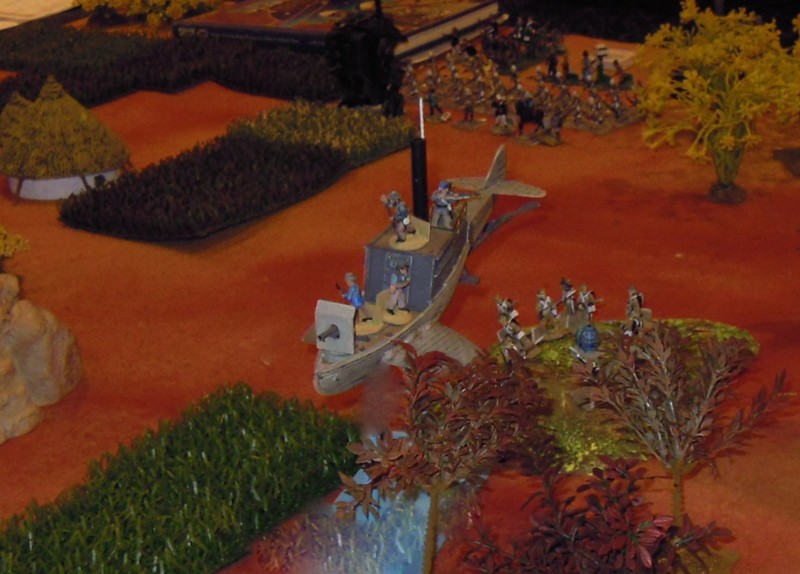
Here's a closer view of one of the two Shark flyers. I kit-bashed these almost twenty years ago from the hull of a light siling vessel, a superstructure built up from sheet styrene, and the tail of a WW I spad. The forward deck gun was from the old Houston line. They still look pretty cool to me. We called them sharks because, despite the odd-sounding mix of parts, they do have a sort of graceful shark-like shape.

More encounter monsters, this time several flying predators attacking a party of Martian shield gunners. The flying predators, looking a bit like alien manta rays -- which is just about perfect for Mars in Space: 1889 -- are from the old Grenadier Models Traveller animals set. There are a lot of useful alien critters in that boxed set, if you can find it on ebay.

American Marines have stormed ashore from the Martian Queen and are now pushing inland. Note the steam tractor standing by as a towing vehicle for the Amazonian gun crew (only one figure visible at the far right).

Having captured a village, the Amazonian infantry and field gun deploy to defend the North American beachhead. The barge used to bring their heavy vehicles is visible beached in the background. Actually, the attack wasn't long in coming. Pretty much everyone in range decided to beat up on the Americans.


Starting with the Russians.


Meanwhile the French Turcos, in true light infantry style, scrambled up a jagged mountain and uncovered the fossilized remains of a large but unknown species of Martian animal.

Tuesday, August 14, 2012

My Sinister Mars Needs Steam Minions

Tome Harris, Christin Sciulli, and I ran Mars Needs Steam twice at Historicon a couple weeks ago and we had a great time doing it. We must have run twenty or more folks through the two games, pitting the Forces of Freedom against their bitter foes, the Forces of Justice. Tom and Christin both came in costume and Christin's mom sewed her terrific Victorian hussar outfit (complete with bustle!). She won a gamemaster award for the great job she did, and very well-earned. Going that extra mile to make the gaming experience special is what turns a good game into a great one.

Me and Christin. Her hussar busby has a death's head skull, but with one cybernetic eye (of course) which you can just see by the plumes. It's more clear in the picture at the top of the post.


Me and Tom. That is a genuine archaeologist's pith helmet, by the way -- used by Tom when he was an undergraduate in archaeology.

Thanks a bunch, you two. Those were serious ass-kicking games. Pictures from the games tomorrow or the next day.

Monday, August 13, 2012

Space 1889 and Beyond Season 2 Preview

Season two of Space: 1889 and beyond is just about here, and Untred Reads is offering another season pass. More about that soon. But in the mean time here is the press release from Untreed Reads followed by a preview of Conspiracy of Silence, co-authored by Andy Frankham-Allen and myself.


Coming mid-August 2012
The second exciting series of steampunk adventures!
Everything H.G. Wells could have written.
Everything Arthur Conan Doyle thought of,
but never published – because it was too fantastic!

Following on from the success of the first series, Untreed Reads Publishing is proud to present the second series of six books based on the world-renowned Role Playing Game, fully licensed from creator, Frank Chadwick, and headed by best-selling author Andy Frankham-Allen.

The series begins mid-August, and will be released bi-monthly, thus running for a whole year. Once again we’ve brought together some of the best names in fantasy fiction as well as some relatively new names to bring you a series that will continue to re-shape the popular steampunk universe first created almost twenty years ago.

This series our heroes, “Professor” Nathanial Stone and Annabelle Somerset are joined by two others on their journey through the aether. Captain Jacob Folkard, the commander of HMAS Sovereign, and another familiar face. There is much turbulence and change ahead, as secrets are unveiled, mysteries revealed, with the fate of the British Empire hanging in the balance. Think you’ve seen it all? Think again. Join Nathanial, Annabelle, Folkard and guest as they travel from one corner of the Space: 1889 universe to another, from the conspiracies that eat away at the heart of the British Empire to the underworld of Ceres, watch them as they encounter pterodactyls in the clouds above Venus, join them on their longest journey between worlds where it seems their darkest fears follow them all the way to Phobos and the mysteries contained inside that moon… Where will their journey end? Nothing is certain, except that by the end of series two the 1889-verse will be shaken to its very core!

Previously On…
At the end of the last series, Nathanial and Annabelle found themselves in something of a tight spot. Annabelle lost one of her legs due to the machinations of the manipulative French man, Le Boeuf, on an experimental heliograph station, and Nathanial found himself placed under arrest for the destruction of said station. It seemed things were looking up for them after they helped rescue Annabelle’s increasingly mad uncle, inventor Cyrus Grant, and foiled a Russian plan to secure the moon and the alien Heart at its centre. But as series one closed, Annabelle was disheartened by her uncle’s deterioration, despite the support of Lieutenant George Bedford, first officer of the Royal Navy’s flagship HMAS Sovereign, and Nathanial was left to ponder his own future. He hopes that his actions on Luna will give his innocence some credence, but is concerned about the reception awaiting him on Earth… No one but he and Annabelle survived the destruction of Peregrine station, so who is behind the charges levied against him?

Series two begins mere hours from where series one left off, with the series creator, Frank Chadwick, joining forces with series editor, Andy Frankham-Allen, to bring you a tour-de-force in Space: 1889 adventure!


The Stories
1.      Conspiracy of Silence by Andy Frankham-Allen & Frank Chadwick
2.      To Ceres by Steam by Paul Ebbs
3.      Leviathans of the Clouds by Steven Savile & David Parish-Whittaker
4.      The Forever Journey by Oli Smith
5.      A Fistful of Dust by Sharon Bidwell
6.      Horizons of Deceit by Jonathan Cooper


The Team
Andy Frankham-Allen (left, series editor and co-author, Conspiracy of Silence) is a Welsh-born author of many short stories, both for Untreed Reads and the Big Finish’s official range of Doctor Who anthologies. In 2005 he co-authored the last in Noise Monster Productions range of Space 1889 audio dramas, and in early 2011 Untreed Reads published the first novel in his new real world dark fantasy series, The Garden, which was nominated for the Rainbow Award, Best Full-Length Supernatural Novel 2011. He continues to write short stories and novels, with upcoming projects including a novel in Crossroads Press’ Scattered Earth series, and non-fiction Doctor Who book for Candy Jar Publishing, as well the second book in The Garden series. On top of all that, he’s also the series editor for Space: 1889 & Beyond.
Frank Chadwick (right, series creator and co-author, Conspiracy of Silence) is no stranger to the Victorian science fiction field. He is the creator of the Space: 1889 universe, with the first in a series of role-playing adventures, board games, and miniatures rules appearing over twenty years ago. He is known throughout the gaming industry as one of its most prolific designers, with over a hundred published games. He is also well-known in the history and military affairs field, with over two hundred books, articles, and columns. His 1991 Desert Shield Fact Book reached number one on the New York Times bestseller list, but he still lists steampunk as one of his first and greatest loves. As well writing one and a half novels in the first series of Space: 1889 & Beyond, his forthcoming works include two novels with Baen Books, How Dark the World Becomes and The Forever Engine which is set in the Space: 1889 universe.

Paul Ebbs (left, author To Ceres by Steam) has written various Doctor Who related things for the BBC, Big Finish Productions and BBV, and as a TV writer he’s written for such notable shows as EastEnders, Casualty, The Bill and Dead Ringers.

Steven Savile (right, co-author, Leviathan of the Clouds) has written for Doctor Who, Primeval, Stargate, Warhammer, Slaine, Fireborn, Pathfinder and other popular game and comic worlds. His novels have been published in eight languages to date, including the Italian bestseller L’eridita. He won the International Media Association of Tie-In Writers award for his Primeval novel, Shadow of the Jaguar, published by Titan, in 2010, and has been nominated for the British Fantasy Award on multiple occasions. Silver, his debut thriller reached #2 in the Amazon UK e-charts in the summer of 2011 selling over forty thousand copies in the process. He wrote the story for the huge international bestselling computer game Battlefield 3, which sold over five million copies in its week of release, and he served as head writer on the popular online children’s game SPINEWORLD which have over one million players. His latest books include Tau Ceti (co-authored with International Bestselling novelist Kevin J. Anderson), Each Ember’s Ghost and the novelisation of the computer game Risen 2: Dark Waters.

David Parish-Whittaker (left, co-author. Leviathan of the Clouds) was a winner of the Writers of the Future contest for emerging talent in speculative fiction for his short story A Warbird in the Belly of the Mouse. He’s previously written tie-in fiction for the Rezolution miniatures ruleset by Aberrant Games, to be published in an upcoming anthology. His short fiction has also appeared in Every Day Fiction. He currently writes videogame analysis and reviews for Geekosophy and Bag of Games. When he’s not writing, David works as a captain for a national airline. In previous incarnations, he has been a naval flight officer, traffic watch pilot, glider tow pilot and aerobatic instructor. He is a rated commercial glider pilot, and holds an H-2 hang glider rating. In his off hours, he plays a replica medieval harp for the Goliards, an early music group specializing in 13th – 15th century music, mostly to cement his geek street cred.

Oli Smith (right, author, The Forever Journey) spent two years as a freelance writer working on novels, audio books, comic strips and video games for the BBC series Doctor Who. Now he works as a creative producer for London-based video games company Mediatonic and spends his evenings playing board games. He still likes writing, retro sci-fi and RPGs so it looks like Space: 1889 has got him covered.


Sharon Bidwell (left, author, A Fistful of Death) was born in London on New Year’s Eve. The first short story she submitted — Silver Apples of the Moon— was accepted by Roadworks Magazine. The editor announced her as ‘a writer who is going places’ and described the story as having ‘both a Sci-fi and horror element,’ and being ‘strong on characterisation, and quite literary, in terms of style.’ With a repertoire of twisted tales and a love of cross-genre writing, it surprised everyone (including herself) when she branched out into erotic romance. These works have been critically acclaimed and often described as ‘deeply passionate’. Sharon’s worlds are vivid, unexpected and sometimes intensely magical. She is the author of the best-selling gay romances ‘Snow Angel‘ and the sequel ‘Angel Heart’. Sharon writes whatever her warped mind can come up with. Although her longer works to date mostly involve a variety of wonderful men finding true love…or at least some loving, she’s quite capable of writing something darker, grittier, and even outright twisted.
Jonathan Cooper (right, author, Horizons of Deceit) was born in Wolverhampton in 1981. He started his career in theatre, writing plays from the Birmingham REP and the King’s Head in Islington. He has written extensively on the web on film, TV, video games and other assorted geekery, including a stint producing reviews and opinion for Mirror.co.uk. He has written and produced two short films with another two in production and has had short stories published internationally – he is also, according to the BBC – one of the top 200 comedy writers in the UK. Horizons of Deceit is his first full-length science fiction piece, and he remains bizarrely proud of the day Steven Moffat threatened to set his eagles on him.

Adam Burn (left, cover designer) has been drawing from an early age, and has been working with digital art for at least seven of them. He is a freelance artist who has worked for Games Workshop and Fantasy Flight Games. He was, most recently, the Senior 2D Artist for Taitale Studios on their forthcoming MMORTS game, Novus Aeterno. Steampunk is a new genre for him, but one he’s finding his way around quickly, and he is responsible for the covers of series two, as well as the revamp of the Space: 1889 & Beyondlogo.

Exclusive: Conspiracy of Silence (prologue)
1.
“AETHER PROPELLOR SECURED and ventral mast shipped, sir.”

“Very good, Mister Barry.” Lieutenant George Bedford, acting captain of HMAS Sovereign, the most modern aether battleship in the Royal Navy, took a quick scan of the bridge instruments and engine room repeaters before turning back to the young sub-lieutenant. “At what would you estimate our drop, Mister Barry?”

Barry had only worn the single thick stripe of a sub-lieutenant for eight months and Bedford hadn’t known him as a midshipman. The youngster had a good level head on his shoulders, Bedford had learned that much about him several weeks earlier when the two of them had dropped half a dozen Saltators—giant lunar red ants—with revolver fire when the monsters had boiled unexpectedly out of the hatch of a cutter on the docking bay. His technical skills were another matter, but they were coming along.
Barry squinted through the lens of the horizontal inclinometer, aimed out the bridge’s starboard observation blister, consulted his pocket watch, waited ten seconds and took a second reading through the lens. He paused, doing the calculation in his head.

“I make the drop fifty-five fathoms per second, sir.”

Bedford nodded; he made it nearly the same. Fifty-five fathoms a second, a descent rate of almost four miles a minute, was a bit steep and on this trajectory would put them down in the North Atlantic instead of the English Channel, as well as scorch the lower hull. “Trimsman, let’s have fifteen percent buoyancy on the lifters.”
“Fifteen percent buoyancy, aye, sir,” the petty officer answered and went to work on his forest of levers, each controlling the angle of one of the liftwood louvers which covered much of Sovereign’s lower hull.

“Mister Barry, my compliments to Lieutenant Boswell and he may light the coal boilers at his discretion.”

“Sir.”

They wouldn’t have enough atmospheric oxygen for the boilers for another ten minutes or so, but Boswell, the chief engineer, knew that well enough. The sun was still visible above the curvature of the Earth and would remain so all the way down through cloud-free skies. Although it was not yet day in Southern England, the eastern sky would already be pink and the sun would rise full up in the hour their descent from orbit would take, racing as they were toward the dawn. The solar boilers would do until Boswell put the black gang to work, would probably suffice until the last ten minutes of the flight, when they would penetrate the near-permanent cloud and smoke cover over Greater London. No solar boiler yet made would work down under that grey-brown shroud.

Bedford took another look at the bridge, its gleaming brass instruments and polished mahogany panelling, and he sighed. In an hour, a bit more, Sovereign would be down and secure at Chatham Dockyard and his temporary command would end. There was no chance for a simple lieutenant with eight years seniority to land a permanent command such as this—the choicest command in the fleet, coveted by officers with two more stripes on their cuffs and with the all-important political backing and social standing he lacked. No, he would be reassigned. In the past he had always looked forward to a new assignment, but not this time. After commanding Sovereign, however briefly, no other assignment had the capacity to stir his blood. Damn, she was a fine ship!

More than that, she held memories. Were it not for his assignment to HMAS Sovereign, he would never have met and befriended Nathanial Stone, and would not now be delivering him to the police for trial as a traitor and saboteur. He would never have met Cyrus Grant, one of the greatest scientific minds of the age, now reduced to confusion and madness by their experiences on Luna. Most importantly, he would never have met Grant’s niece, Annabelle Somerset.

Annabelle…
2.
NATHANIAL WATCHED AS the line of Russian former captives was led to the steam omnibus waiting at dockside. The irony of their situation and his washed over him like a cold wave. Former enemies of Britain, they, along with British personnel, had been captured by the alien Drobates on Luna, and all had been rescued by Bedford’s daring raid, leading fewer than a dozen Royal marines and naval ratings. Now the Russians would be released, amidst much public fanfare, to the custody of the Russian ambassador, who would in turn express the heartfelt gratitude of the Tsar.

In the subsequent fighting which had nearly cost all of them their lives, the Russians had done nothing to help while Nathanial, with a captured Drobate electric rifle, had held a long, dim tunnel against an alien horde, and had done so nearly alone and with little expectation he would escape with his life. Now British soldiers helped the Russians into the steam omnibus, showed them every courtesy, while a quartet of hard-eyed constables marched purposely toward Nathanial, obviously intent on taking custody of him from the two Royal Marines who guarded him.

Nathanial had at least expected to be met by some sort of government official, have the charges explained. Instead a black police four-wheeler loomed behind the constables. Were they really simply going to pack him up and cart him off to prison with no further ado?

Nathanial looked for any sign of his friends. Captain Folkard, who had relieved himself of command of Sovereign after the disastrous events on Luna had played themselves out, was nowhere to be seen on the dock, but Nathanial spied Annabelle making her way to him on the arm of Lieutenant Bedford, both of them limping. Bedford had suffered a nasty sprain of his ankle on Luna and Annabelle… Months earlier Annabelle had lost her right leg above the knee and now wore a mechanical limb designed by Nathanial and built using Drobate technology over the course of the last few weeks. It seemed to serve her well, the only bright spot in this uniformly bleak scene.

“Is this Stone?” the leading constable asked.

“Of course it is,” Private Jones answered, bristling slightly. “And what of it, then?”

“It’s all right, Private,” Nathanial said. “It is clear enough they are here for me. If you gentlemen would be so good as to give me a moment to take my leave of my friends, I would appreciate it.” He addressed this last to the leading constable.

Instead the man gestured to his assistants. “Seize him and put him in the van.”

“No! Just a moment, please!” Nathanial entreated but to no avail.

Two constables pinned his arms to his side and pulled him toward the black carriage. A few yards away Annabelle cried out and broke free of Bedford, reached out to him. The leading constable made as if to stop her but Jones’s rifle was suddenly in his hands at high port.

“Touch the lady, friend, and you’ll be chokin’ on your teeth,” Jones growled and the constable took a step back.

“Nathanial,” Annabelle said and thrust something round, flat, and metallic into his hand, “take this and remember—never lose hope.”

The constables pulled him away and he saw George Bedford comforting Annabelle as the doors on the back of the van closed and plunged him into darkness. He looked at his hand and saw a small gold watch, gleaming dully in the faint light which entered through the overhead ventilator. He recognised it as the pocket watch her father had given her—which contained on its inside a daguerreotype of her deceased parents; the only thing she retained from that former life.

Never lose hope.

Saturday, June 23, 2012

Upcoming Convention Gigs

I'm getting ready to shove off for Tempe Arizona and it occurred to me you might like a preview of where I'll be showing up this summer.

Next week I'll be the guest of ConSimWorld Exo out in Tmpe Arizona. (I'll be there late Monday the 25th through Thursday the 28th, with the 19th a travel day.) I'll be giving two talks out there, one on the Battle of Borodino in 1812 and the second my thoroughly revisionist take on Alexander's conquest of the Persian Empire.

In July I'll be at Historicon in Fredericksburg, Virginia from Thursday the 19th through Sunday the 22nd. No lectures there, just a number of games, including a couple rounds of Men Under Fire (which will be released at the show -- it just went to the printer) and two spectacular Mars Needs Steam games I'll be running with Tom Harris and Christin Sciulli. Tom and I will have a couple new vehicles, Christin's making a Victorian female hussar outfit just for the show, and Glenn Kidd's made some custom terrain which will make this the best-looking game we've run so far. Lots of pictures to come from that show.

In late August early September I'll be the guest of Celesticon out in San Francisco over the Labor Day weekend. I'll be there from Friday the 31st through Monday the 3rd with a nice busy schedule. I'll be doing a join panel on the Battle of Borodino with Dana Lombardy, giving my Alexander and the Persians talk again, I'll also be running a Men Under Fire game and a Mars Needs Steam game, with local assistance from Rich Schuldt and the loan of figures and terrain from his collection. I saw them last year and they really are spectacular.

Plan to stop in and say hi if you're in the area.

Tuesday, June 12, 2012

Sneak Peek at the German Space: 1889 RPG


Big news!

Uhrwerk Verlag has some sample art up on the upcoming German Space: 1889 role-playing game along with an overview -- in German, of course, but if you use the Google toolbar translating program it can easily convert the web page to -- well, maybe not English exactly, but sorta close ("Who Space: 1889 is not yet known: This role-playing adventure into between steam, air and adventure!") Hmm. Let's call it "Googlish."

. It looks as if the core rules will ship in July and the Venus worldbook is in the works to follow soon. I've previewed some art earlier and everything I've seen so far for this game is top-notch. As I mentioned earlier, if the German edition is well received (and it looks as if it will be) there's a very good chance of an English-language edition to follow.

Here's the link to the Uhrwerk Verlag announcement. Go take a look.

Tuesday, May 22, 2012

Why Are E-Books Such A Big Deal? Part 1


I've said before here that everyone (including me) has an opinion about where e-publishing is going, but nobody (including me) really knows. The reason is the landscape is changing so fast. One element of human psychology is "presentism," (although I don't think that's exactly the term generally used) but what it means is that only the present is real and so we psychologically assign enormous weight to it -- correctly, for the most part. But it also means we have an easy time believing in gradual change but a very hard time believing in the possibility of sudden and very dramatic change. Hardly anyone foresees catastrophes, and those who do are branded crackpots, although to be fair, they are vastly outnumbered by the genuine crackpots who predict catastrophes all the time and are always wrong. What does that have to do with the future of e-publishing?

E-readership is expanding at a rate which, were it a disease or a climatic shift, would clearly be catastrophic. A study from Bowkers (one of the big names in publishing) which came out this last week drives that home. The study was of e-readership in the United Kingdom. Here are some of the remarkable changes it identified.

Effectively one third of all Brits are now or will soon be e-readers. 31% self-identified themselves as likely to purchase an e-book in the next six months. That's a big number, but what sort of a trend does it represent? The number of adults in the UK who have purchased an e-book has nearly tripled in the seven months from February of 2011 to the information cut-off of the study.

Tablets have become the reader of choice, with Kindle dominating the tablet market, with consumers purchasing well over one million of the eReaders per week from the fourth quarter of last year on. . I suspect the iPad is coming on strong, even though it is not a dedicated eReader.

So where this is going is anybody's guess. One effect has been the explosion of self-publishing. For the first time in history, authors have a nearly unrestricted access to the global marketplace, for better or worse. (One of the gatekeepers standing between authors and readers in the past was the editor, and lots of self-published eBooks would have benefitted from that particular gatekeeper having remained in place.)

Lots of folks will guess wrong about what this means for the future, but the one guess you can be certain is wrong is that this is all just a passing fad and won't have much long-term effect on publishing.

I labeled this entry "Part 1," because I'm sure I'll end up revisiting this subject again.

Monday, May 14, 2012

Space 1889 Novel to be Published by Baen Books

Yesterday I promised you some big news and here it is.

I told you several months ago that Baen Books was publishing my novel How Dark The World Becomes. When they contracted for that book they asked if I had anything else for them to look at. I did: The Forever Engine, a Space: 1889 novel. I sent it off, we've talked several times since then, and Friday I signed the contracts and dropped them in the mail. A Space: 1889 novel will see print in the near future from one of the top science fiction publishers.

I don't have a release date yet. I'm working on some rewrites and once those are locked down to everyone's satisfaction Baen will come up with a date. But in the mean time this is very exciting stuff for me.

The novel actually takes place in 1888 and some of the events and characters from The Forever Engine appear as background incidents and minor characters in one (so far) of the Space: 1889 and Beyond stories. But it's not a prequill or a lead-in to other stories. It's a great big story which stands all on its own, and deals with nothing less than the fundamental fabric of the universe.

I can't tell you much more about it now. As we get closer I'll lay some groundwork, but right now publication is well over a year away, so everyne gets to work on refining the virtue of patience.

Sunday, May 13, 2012

Great Review of A Prince of Mars!


I just got a great review of A Prince of Mars from the Traveler's Steampunk Blog. Ten out of ten zeppelins! He was very careful to touch on some of the critical features of the story without letting any spoilers slip, which I really appreciate. Those of you who have read it know there are some pretty sharp twists and turns and a place where, if I've done my job right, the readers will smack their foreheads and say, "Oh! Of course!" So I'm glad he didn't let any cats out of the properly-ventilated pet carrier.

Here's a link to the review.

I'd have held off on this announcement until tomorrow, but I promised you big news then and I didn't want to step on that story with this one -- not that this one isn't way-cool.